



Please leave your email address, So that we can get in touch with you as soon as possible.
Vertical transport · Specification reading
Construction Hoist Specification: Reading Load, Speed and Mast Data Before You Commit
The short version: only four numbers in a construction hoist specification decide whether the machine fits your programme — rated load, cage clear dimensions, lift speed, and mast plus tie-in arrangement. The model name is a shorthand, not a guarantee. Everything else on the sheet is either context or decoration, and it is worth knowing which is which before a purchase order goes out.
The Model Name Is a Shorthand, the Rated Load Is the Contract
A construction hoist designation packs several facts into a few characters. The leading letters identify the type — rack-and-pinion construction hoists conventionally carry an SC prefix. The number that follows is the rated load per cage in kilograms. So SC200/200 reads as two cages, 2,000 kg each, while SC100/100 sits in the 1,000 kg class per cage. When you meet a variant such as SC200-200, SCH100-100 or a model with an ZN suffix, the prefix stays the same but the machine behind it changes: speed class, drive type, cage geometry, or a dedicated cargo configuration.
This naming habit is genuinely useful. It lets you sort a quotation list into categories in a few seconds without asking a single question. But the figure you sign against is the rated load, and that figure is tied to a full configuration rather than a bare promise. A cage badged at 2,000 kg carries that rating under specified conditions — cage size, mast sections, tie-in layout, and whether personnel are permitted alongside materials. Add a heavier door option, a wall-mounted cage arrangement and a full crew, and the usable margin narrows. A data sheet states net load; it does not state what a site manager hopes will fit.
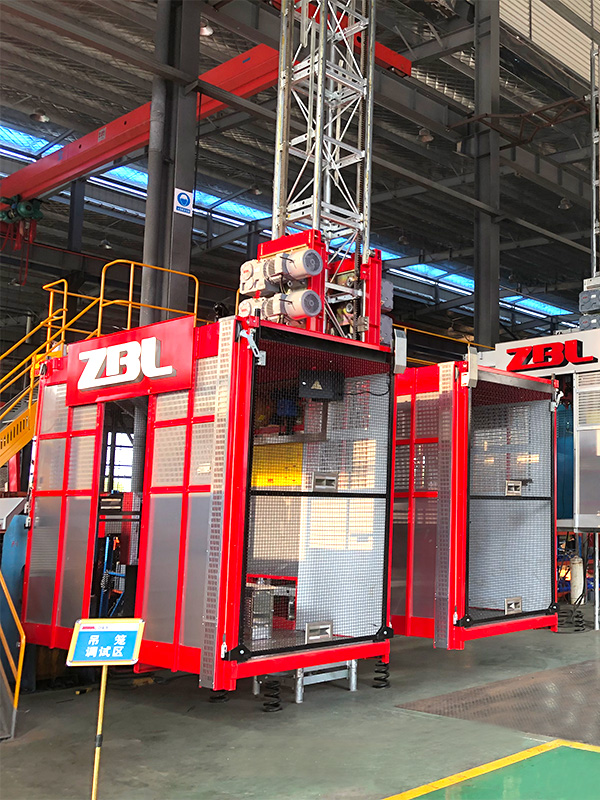
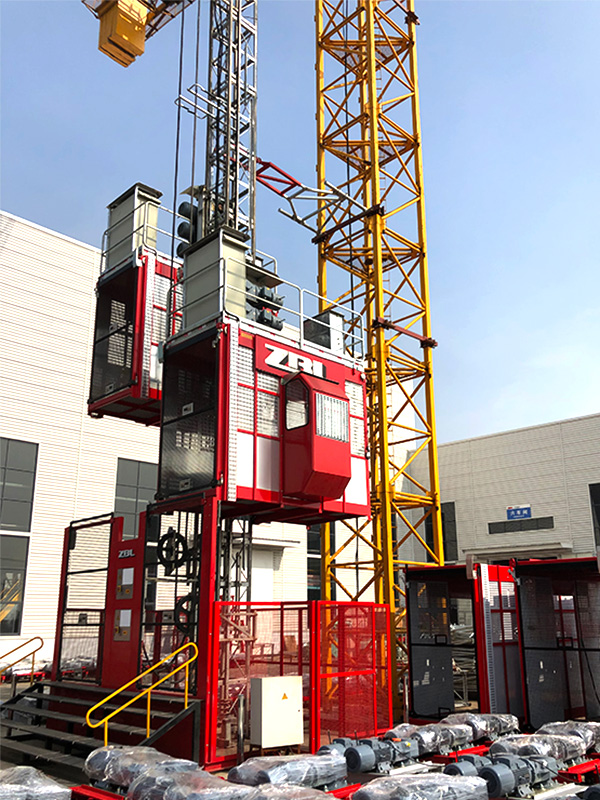
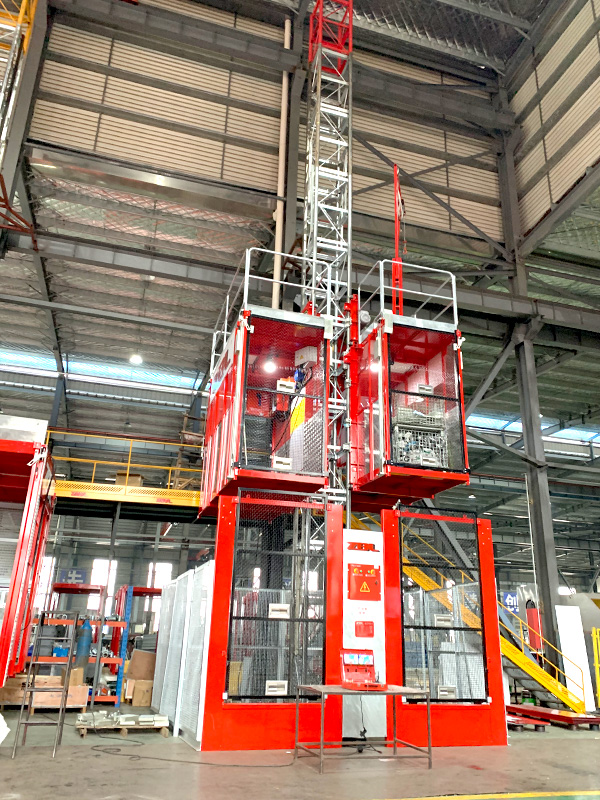
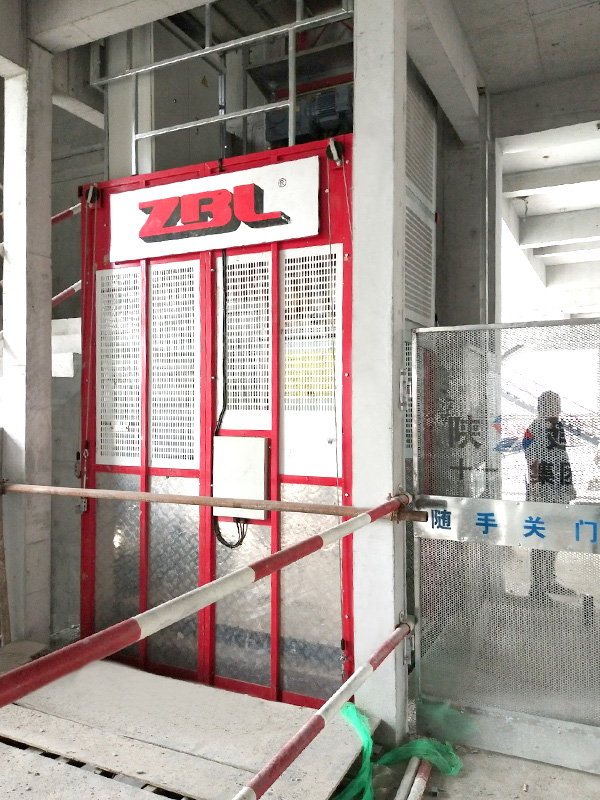 SC200 Series Construction HoistProduct details cover the assembled cage, shaft installation and safety systems, but rated load must be checked against cage size and mast configuration.View Product →
The practical move is to stop treating the model name as a specification and start treating the rated load as the first filter. If a supplier cannot state the per-cage load together with the cage dimensions and the mast configuration it applies to, the number is being used as marketing rather than engineering.
The Four Specification Values Worth Comparing Side by Side
Most construction hoist specification sheets are long. Very few of them are read in a useful order. Compare these four fields first, and the rest of the document becomes commentary rather than noise.
| Field | Typical value on a data sheet | What it actually governs |
|---|---|---|
| Rated load | 2,000 kg per cage, or a single-cage figure given in kg | How much material and how many people move per trip — cross the figure and you need a second cage or a larger one |
| Cage clear dimensions | Often around 3.2 m length, 1.5 m width, 2.5 m height, subject to model | Whether the load actually goes in: pallets, rebar bundles, concrete skips and sheet material |
| Lift speed | Roughly 34 to 40 m/min for fixed-speed units; a wider adjustable band for variable frequency drives | Floor-to-floor cycle time and the shock each start and stop sends into the tie-in points |
| Mast section and permitted height | Mast sections commonly 1.508 m; permitted height depends on the tie-in layout | How the machine climbs as the building rises, and when anchor points must be ready |
A sheet that lists load and speed but buries cage geometry and mast data in a footnote is not a technical document. It is a brochure with numbers attached. Ask for the complete version, and ask which of the four fields change when the configuration changes.
Lift Speed and Drive Type Move the Programme More Than the Load Rating
Speed is a downstream consequence of drive choice rather than an independent feature. A fixed-speed hoist is mechanically straightforward and its starting current is easy to predict, which matters on a site with a restricted supply. A variable frequency drive spreads acceleration across a controlled ramp, allows slow creeping for accurate levelling at a landing, and keeps torque available at low output speed when a cage is fully loaded.
On a residential project running two shifts, that difference compounds across every trip. Cycle time is not simply distance divided by rated speed — it includes acceleration, deceleration, door cycles and the operator's confidence in the stopping point. A drive that levels cleanly and starts without a jolt shortens the tail of every trip, and there is a reasonable explanation of how a 37 kW variable frequency drive changes SC200/200 behaviour for readers who want the electrical detail.
 SC200/200 Variable Frequency Low-Speed Construction HoistThe model pairs a 2,000 kg rated load with 0–40 m/min lifting and a 37 kW VFD for smoother starts, stops and levelling.View Product →
The trade-off between low-speed and medium-to-high-speed variable frequency models is rarely about headline metres per minute. It is about where you want the machine to sit on the curve between trip time and landing precision. A tower with closely spaced floors rewards accurate levelling; a tall shaft with long runs rewards the faster band. Both are legitimate, and neither is universal.
Cage Dimensions, Door Options and the Cargo Question
Payload is measured in kilograms, but sites load in cubic metres. A cage rated at 2,000 kg will refuse a bundle of scaffold tube that weighs 1,600 kg if the bundle is 3.4 m long. This is why cage clear dimensions belong next to the load figure rather than in an appendix, and why the door arrangement deserves the same attention as the frame.
A hoist that satisfies the load rating on paper but not the cage volume on site costs you a second lift every cycle — and that second lift is the number that turns up in the programme review.
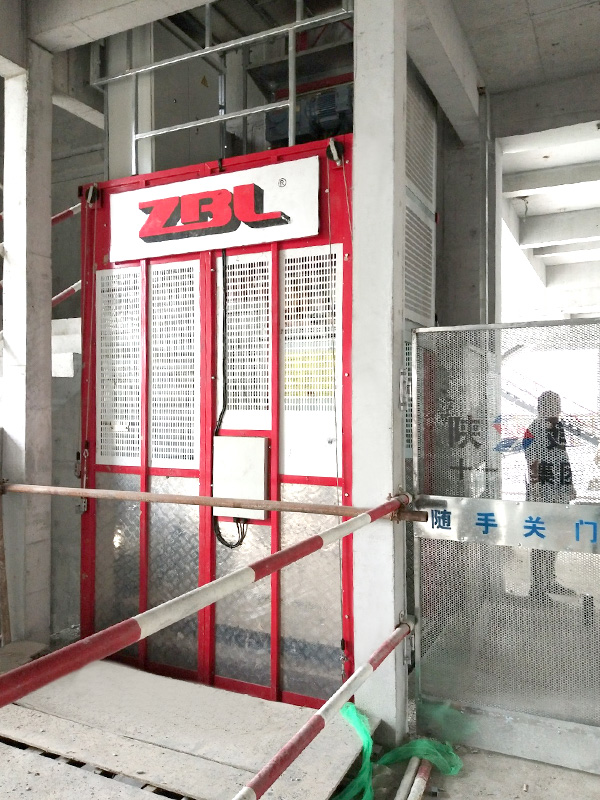
Door selection is a working detail with real consequences. Ramp or barrier arrangements speed up barrow and pallet handling but add weight and change the effective opening height. Sliding doors suit tight landing positions. Wall-mounted cage options change how the machine sits against the structure and therefore how tie-ins are positioned. Cable guiding sections, in turn, protect the trailing cable from snagging as the cage travels — a small component that quietly determines how often a fault interrupts the shift.
Where material handling dominates the schedule, a dedicated cargo machine rather than a dual-purpose unit tends to be the better fit: a larger floor, simpler access, and no ambiguity about who may ride in it. Large combined-assembly cages extend the same logic further, trading a bigger footprint at the landing for fewer movements overall.
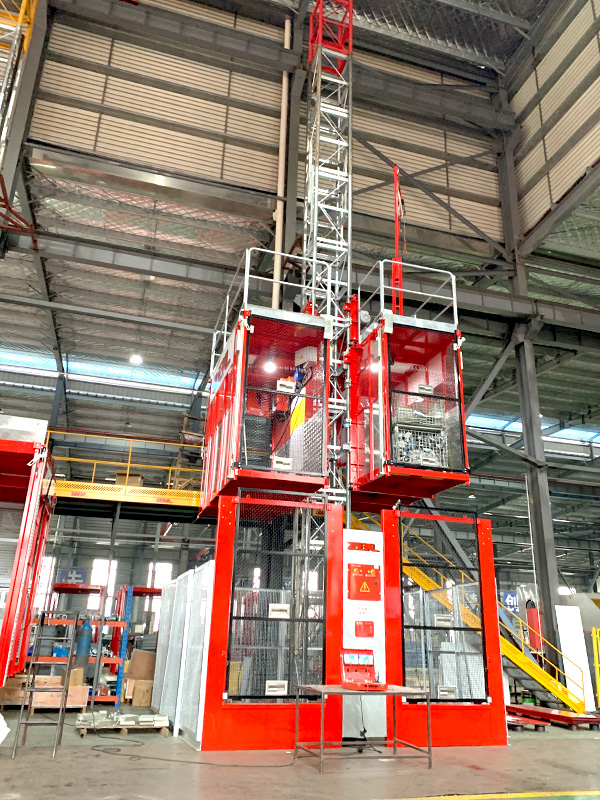 SCH100/100 Variable Frequency Cargo HoistA 1,000 kg non-passenger cargo hoist for low-rise sites, with remote control, video monitoring and automatic levelling for material handling.View Product →
Mast Sections, Free-Standing Height and Tie-In Spacing
Once the building passes the free-standing limit, the hoist is only as capable as its anchoring plan. Mast section length sets the increments in which the machine can climb, so a section of roughly 1.5 m produces a fairly fine height resolution while longer sections reduce the number of joints to inspect. Permitted free-standing height and tie-in intervals are configuration-dependent figures, and they usually appear at the bottom of a data sheet where nobody reads them until the first anchor point is late.
The procurement consequence is a scheduling one. Every tie-in needs a structural location, a fixing method and a safe access route for the person installing it. If the specification states a tie-in spacing that the building's façade cannot accommodate — a curtain-wall elevation, for example, or a floor plate without a suitable fixing zone — the machine is technically correct and practically wrong.
Ask for the mast and tie-in schedule as a drawing rather than a sentence. If a supplier cannot produce it before the order, they will be producing it during the installation, which is the wrong moment.
Electrical and Safety Specifications That Sit Below the Headline
Power supply is one of the most common sources of delay on a hoist installation, and it is entirely predictable at the quotation stage. Confirm the voltage and frequency the machine is built for, the starting current profile of the chosen drive, and the capacity the site's temporary supply can actually deliver at the hoist position rather than at the substation.
Safety devices are specified in the same document and should be listed by function, not by abbreviation: the overspeed safety device and its certified setting, upper and lower limit switches, cage door interlocks, the overload indication, and the wind monitoring arrangement if the site is exposed.
Worth flagging early: a hoist specification that quotes a maximum height without stating the corresponding tie-in layout and wind limit is incomplete. The height figure only holds for a defined anchoring arrangement, and a change to that arrangement after the order can invalidate both the schedule and the compliance paperwork.
What to Ask For Before You Compare Suppliers
Quotations become comparable only when the documents behind them are comparable. Send the same request to every supplier and the differences in the answers will tell you more than the price column ever will.
- A full technical data sheet for the exact model quoted, including rated load per cage, cage clear dimensions, lift speed range and motor rating.
- The mast section length, permitted free-standing height and a tie-in spacing drawing for the quoted configuration.
- The electrical schematic with the drive type shown, so the site supply can be checked against the real starting profile.
- Certification for the overspeed safety device and confirmation of the settings the machine will be delivered with.
- A written installation, climbing and dismantling scope, including who supplies the anchor fixings and who signs off each tie-in.
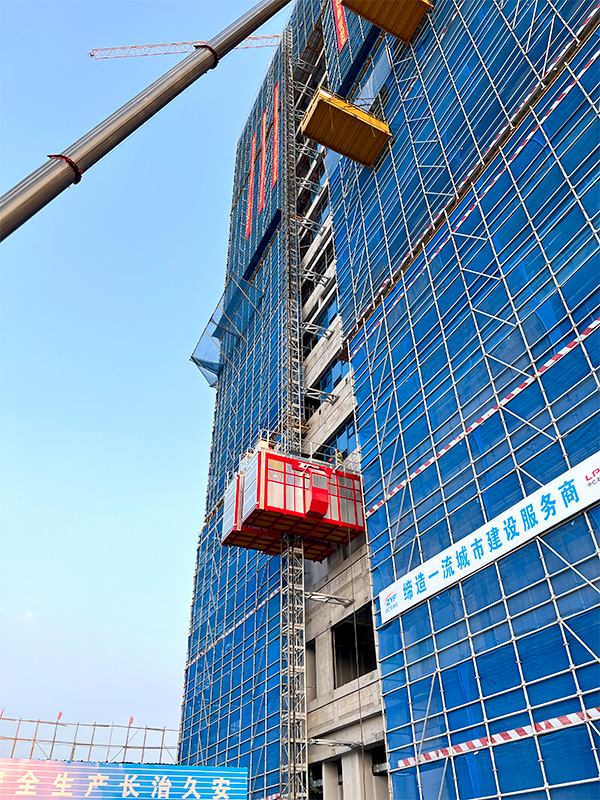
Delivery and support questions belong in the same conversation. A supplier with a genuine manufacturing base and an installation function can answer questions about climbing sequences and site conditions rather than only about catalogue values; the resettlement housing work recorded here is a useful illustration of how those questions look once a machine is on a real high-rise site rather than on a specification sheet.
A Specification Is a Filter, Not a Scoreboard
The instinct when reading a construction hoist specification is to look for the biggest number in each column. That approach produces a machine with an impressive maximum height, an impressive rated load and no clear answer to whether the cage accepts the site's standard pallet.
Read in the right order — load per cage, cage geometry, speed and drive class, mast and tie-in arrangement — a data sheet stops being a list and becomes a set of constraints you can test against the building, the supply and the programme. Constraints that survive that test are the ones worth signing for.
Everything below the fourth field is detail. Useful detail, occasionally expensive detail, but never the deciding factor on its own. Get the four fields right and the rest of the document confirms the decision instead of overturning it.
