



Please leave your email address, So that we can get in touch with you as soon as possible.
Construction Material Hoist: Read the Load Chart Before the Quote
A useful hoist quotation only exists after three numbers have been settled: the heaviest single lift, the largest cage footprint, and the highest stopping floor. Everything else on the specification sheet follows from those three.
The familiar failure is rarely mechanical. A twin-cage machine is booked for a week of block delivery, the handling plan is built around cubic metres rather than kilograms, and the overload limiter cuts the cage out before it leaves the ground. The hoist did exactly what it was designed to do. The selection was already wrong, weeks earlier, at the desk.
So the practical conclusion first: a construction material hoist is a capacity system, not a rental item. Decide the load per cage, then the cage geometry, then the speed and control level. Accessories come last, because they decide whether installation goes smoothly, not whether the machine can do the work.
The cheapest way to size a material hoist is to weigh the heaviest pallet on site and write that figure on the enquiry. Most oversizing and most downtime start with a number nobody bothered to check.
What follows is the order of decisions that keeps a material handling programme predictable, with the tolerances and procurement risks that usually surface only after the machine is on the wall.
The model number is the rated load per cage
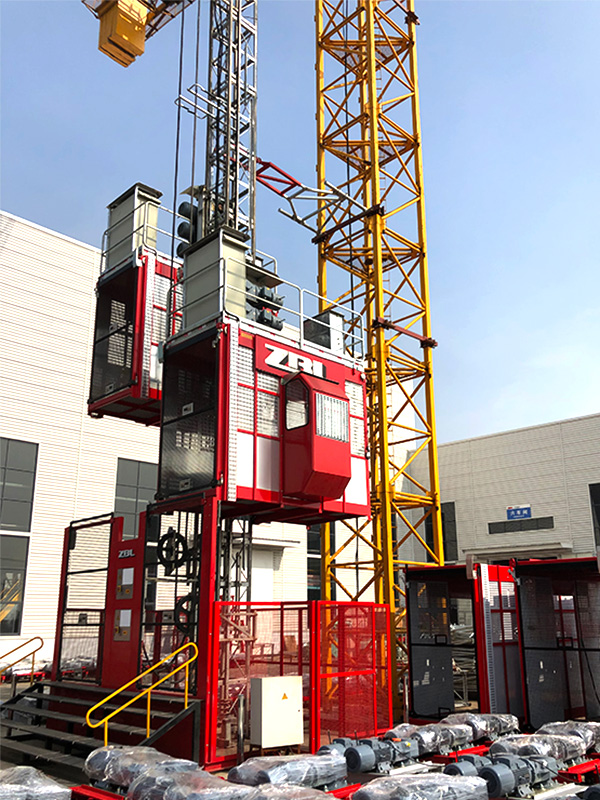
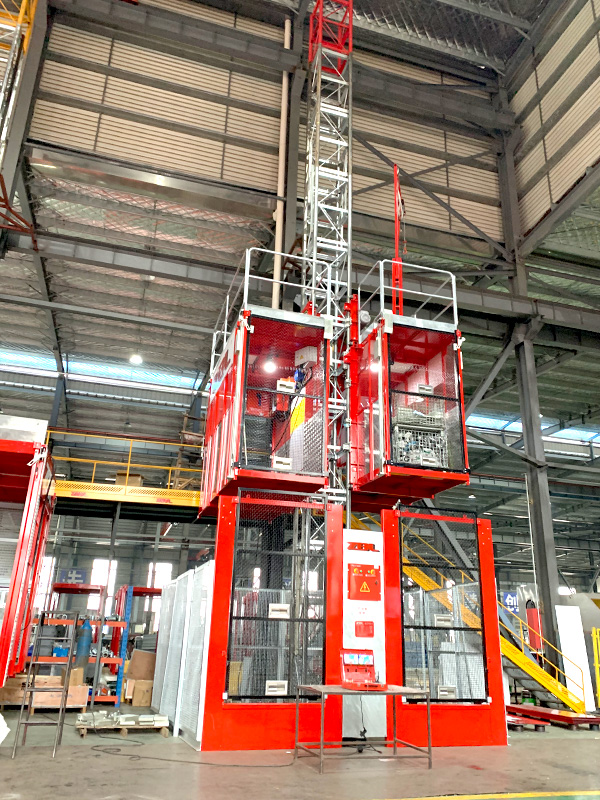
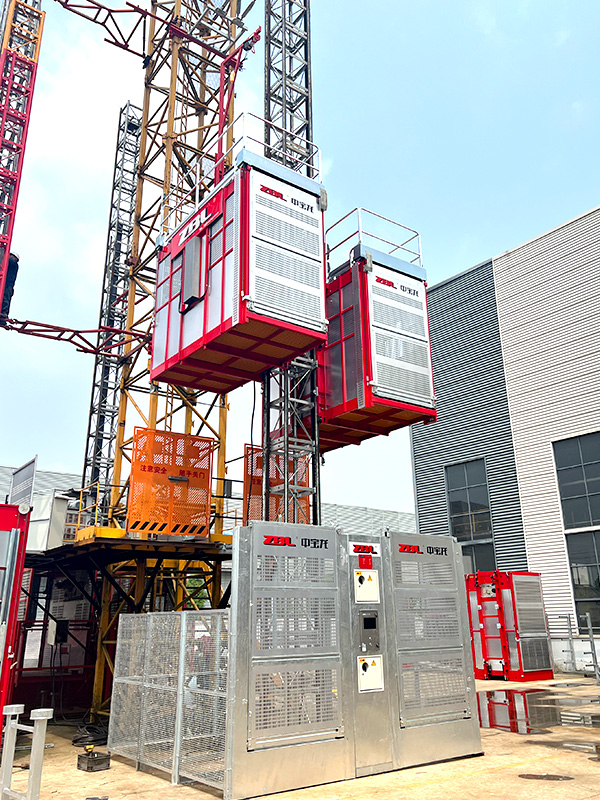
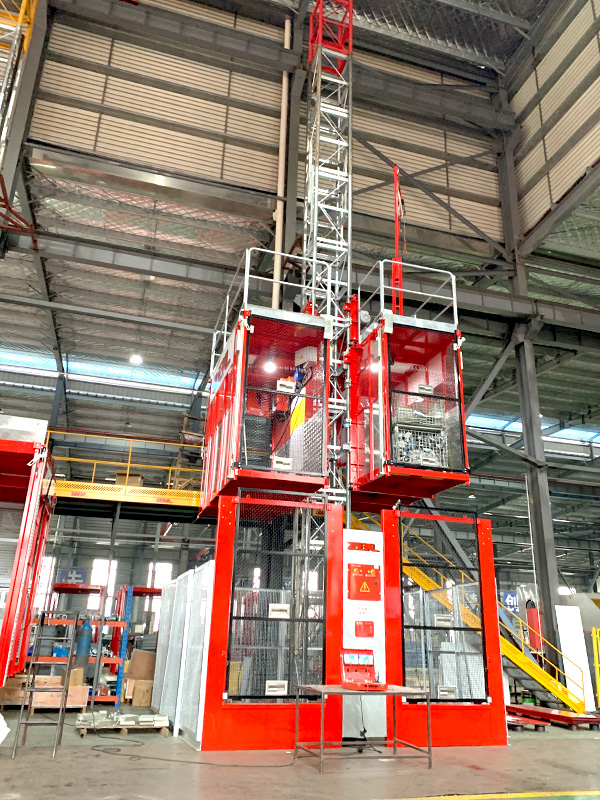
On rack-and-pinion construction hoists, the digits in a model name such as SC200 describe one cage, not the whole machine: 2,000 kg per cage. A twin-cage unit therefore reads as two cages at 2,000 kg each, and each of those limits is absolute. Adding the two together to plan a single heavy lift is the most common arithmetic error in material handling, and it is also the one that damages guides and pinions fastest.
Ask the supplier to confirm in writing whether the quoted figure is payload or gross weight. Cage weight, door assemblies and wall-mounted options all affect what is left for material, particularly on cargo-oriented machines where the cage is built heavier to survive constant loading impact.
A useful habit: put the payload figure on the lift plan itself, next to the maximum pallet weight. When the two numbers sit side by side, the operator stops treating the cage as a general-purpose platform.
Capacity, geometry, speed — in that order
The sequence matters because each step narrows the next one. Reversing it, and choosing speed first, is one of the more expensive mistakes available.
- Rated load per cage. Derived from the heaviest single lift plus a working margin, not from an average daily tonnage.
- Cage geometry and door clear height. Set by pallet dimensions, brick stacks, and any long material that has to enter diagonally or be carried through an open side.
- Travel speed and control type. Relevant once the building passes roughly fifteen floors, or when the cage must stop within a few centimetres of a landing.
- Accessory package. Mast sections, transmission selection, cable guiding, wall mounting and cage matching — the parts that determine installation time and long-term adjustment.
Sizing speed before geometry tends to produce a machine with a fast drive and a cage that cannot accept the loads the site actually moves. The drive system is the expensive part, and it cannot compensate for a cage that is too short or a door that is too low.
Matching the material mix to the machine
Most projects move four or five distinct material families, and each one constrains a different attribute. Reading them against each other early avoids a mid-project argument about change orders.
| Material flow | What it constrains | Confirm before ordering |
|---|---|---|
| Palletised block, mortar, screed bags | Rated load per cage and the tare weight of pallets and stillages | Is the figure a payload figure, and what is the cage tare weight? |
| Formwork panels, steel bar bundles, scaffold tubes | Cage length, door clear height, open-side or wall-mounted configuration | Can the longest item load without being cut, and what is the door opening height? |
| Finishes, tiles, drywall, glazing units | Landing accuracy and low-speed control rather than payload | Does the drive hold position at creep speed with a full cage? |
| Heavy plant, precast elements, large assemblies | Combinational large-cage assembly and cage matching | Is the enlarged cage a factory assembly or a site conversion? |
The table is not a specification. It is a filter: it removes machine options that cannot serve the material list, and it turns vague enquiries into questions with answers.
Where a cargo-only hoist earns its place
When a building is topped out and the traffic is almost entirely finishes and plant, a dedicated cargo machine often makes more sense than converting a passenger unit. A variable-frequency cargo hoist such as the SCH100-100 series is built around loading impact and frequent starts at landings, with the electrical package sized for duty rather than ride comfort.
The trade-off is honest: less attention to ride quality, more attention to cage structure, door durability and how quickly a loaded cage can be placed and released. On fit-out programmes where the same three landings are served all day, that is the correct trade.
 SCH100/100 Series Variable Frequency Cargo Construction HoistA 1,000 kg cargo-only hoist for low-rise sites, with remote control, monitoring and automatic leveling; variable-frequency operation supports steadier starts and stops for repeated landings.View Product →
Variable frequency is an installation argument, not a speed argument
Variable frequency drives are usually sold on travel speed, but the benefit that shows up on site is start and stop behaviour. Controlled acceleration keeps the cage from rocking the mast, and creep speed lets the operator place a loaded cage level with a landing slab instead of dropping it the last few centimetres.
Manufacturers split the category for a reason. Low-speed variable-frequency models suit congested sites and buildings where the hoist shares a footprint with other trades; medium and high-speed variable-frequency models suit tall towers where cycle time dominates the programme. Intelligent variants go further, adding monitoring and unmanned well-shaft operation for buildings where the hoist runs inside a shaft rather than on an external mast.
Procurement risk: a variable-frequency drive sized for a lighter duty cycle will pass the acceptance test and then trip repeatedly in the third month of a two-shift programme. Ask for the duty rating of the drive package, not just the motor rating.
Cage size decides what actually gets lifted
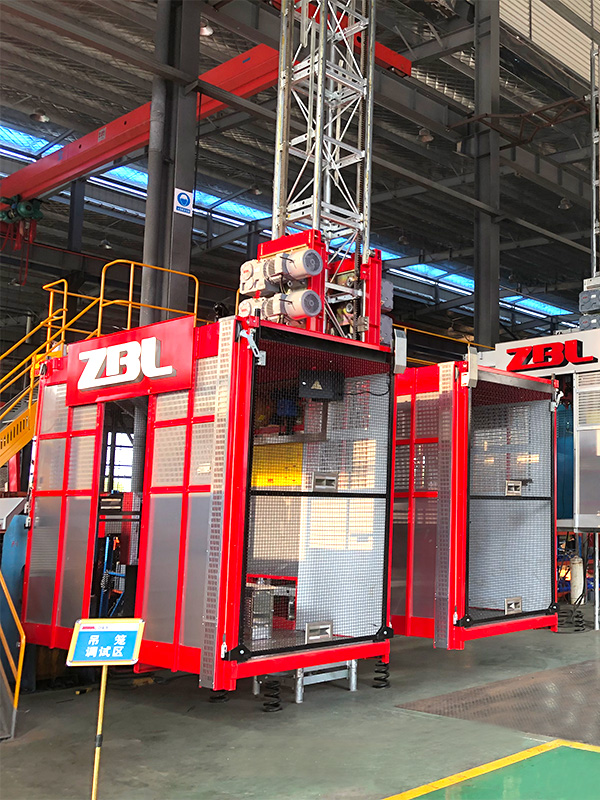
A cage that is 20 cm too short turns every long load into a manual handling problem at the landing, and it will happen forty times a week. Combined assemblies, such as the 4.83 × 2 m large-cage arrangement, exist precisely for projects whose material list includes panels, precast units or oversized plant that cannot be broken down.
Check how the large cage is delivered. A factory-assembled cage arrives complete and is lifted into place once; a site-converted cage depends on the installer's competence and the condition of the existing cage frame. Both work, but only one is repeatable across subcontractors.
 SC200/200DD and SC200/200ED Combination Large CagesLarge hoist cages for extra-long ALC panels and curtain-wall glass, convertible to a 3.2 x 1.5 m cage; suited to oversized components and adaptable assembly.View Product →
The accessory list decides whether installation runs smoothly
Accessories are where budgets quietly move. The machine is quoted, then the site discovers that the mast sections available do not match the tie-in spacing, or that the cage door supplied cannot be opened at a landing with a raised kerb.
- Mast sections — the building block of every metre of travel, and the first item to check for interchangeability across phases.
- Cable guiding sections — protect the trailing cable on tall masts where wind and cage sway cause abrasion.
- Transmission mechanism options — determine service access and the spare parts that must sit in the site store.
- Cage matching, doors and wall-mounted options — the interface between the hoist and how material actually enters and leaves the cage.
Cage matching is worth a separate conversation, because the same base machine serves very different sites depending on how the cage is configured; the practical constraints are set out in this guide on matching hoisting cages to different engineering requirements.
 Construction Hoist Mast Sections for High-Rise and InfrastructurePainted, hot-dip galvanized, compact, maintenance and triangular mast sections form the structural backbone for high-rise and infrastructure lifting, with options for corrosion protection and stability.View Product →
Supplier questions that protect the programme
Manufacturing capability is easy to check and hard to fake. A supplier with its own fabrication hall, automated welding, a surface-treatment and coating line, and a dedicated inspection centre will usually control delivery dates better than an assembler buying finished sections. Where installation, rental and after-sales service sit inside the same company, responsibility for a problem stays in one place instead of being split between a dealer and a service agent.
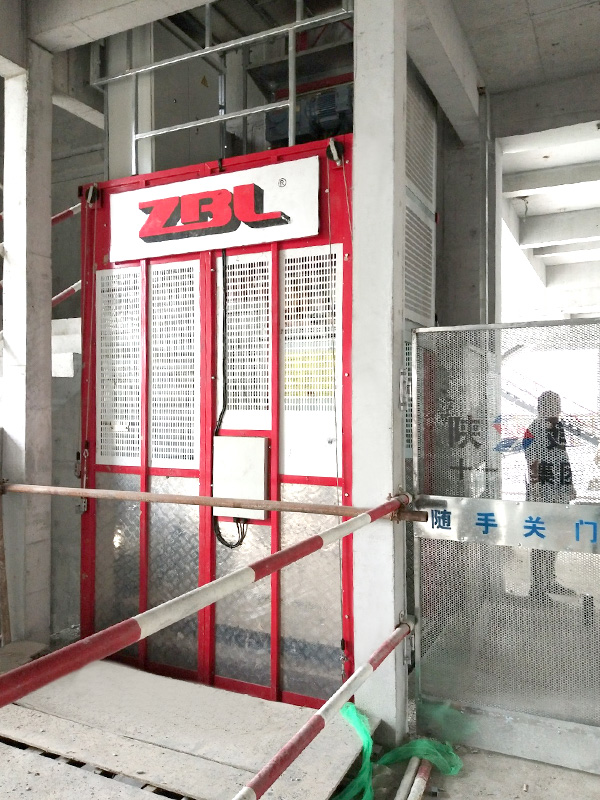
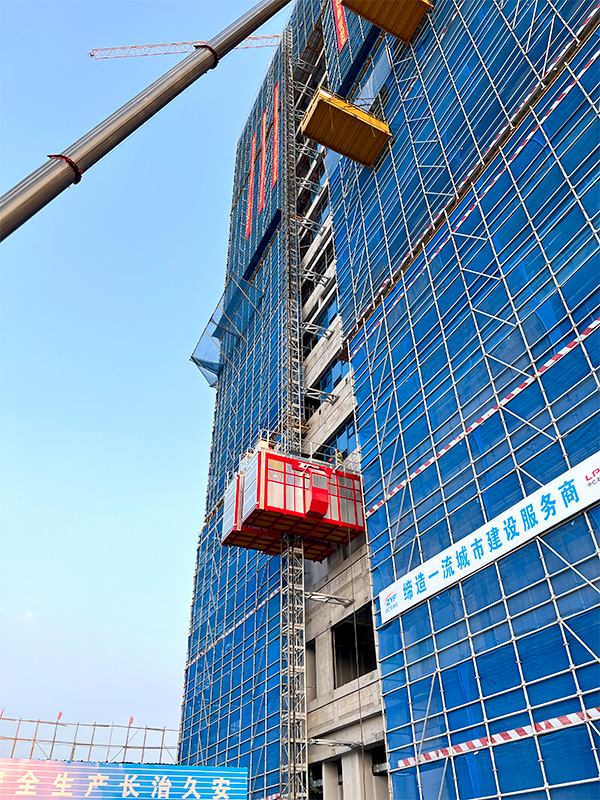
Ask for references that match your building type rather than your city. Residential work, theatre and cultural buildings, office towers and transit-adjacent developments load a hoist very differently; the Xi'an high-tech zone resettlement housing project is a useful comparator for high-volume, repetitive material handling, while public buildings usually demand more careful landing accuracy and less tolerance for noise.
Three questions worth putting in writing: the payload figure per cage, the delivery lead time for mast sections and doors as separate line items, and the name of the technician who will attend the first mast tie-in. The first prevents overload, the second prevents a stalled installation, and the third prevents a two-week argument about who was supposed to be on site.
What to carry into the enquiry
Bring the heaviest lift weight, the longest item, the highest landing and the number of floors served per shift. Those four facts separate a 2-tonne twin-cage machine from a large-cage cargo configuration faster than any catalogue comparison, and they make the quotation comparable across suppliers.
Then check the small print: payload versus gross weight, drive duty rating, mast section availability, and which accessories are included rather than optional. A construction material hoist that matches the load chart on day one rarely becomes the item that stops the programme in month four.
Rule of thumb worth keeping on the wall: if the lift plan cannot name the weight of the heaviest pallet on site, the hoist has not been selected yet — it has only been hired.
