



Please leave your email address, So that we can get in touch with you as soon as possible.
Vertical Transport — Drive Technology
Rack and Pinion: The Drive That Defines a Construction Hoist
Why nearly every passenger and material hoist on a high-rise site climbs a toothed mast rather than hanging from a rope — and what buyers should examine in the gears, the cages and the factory behind them.
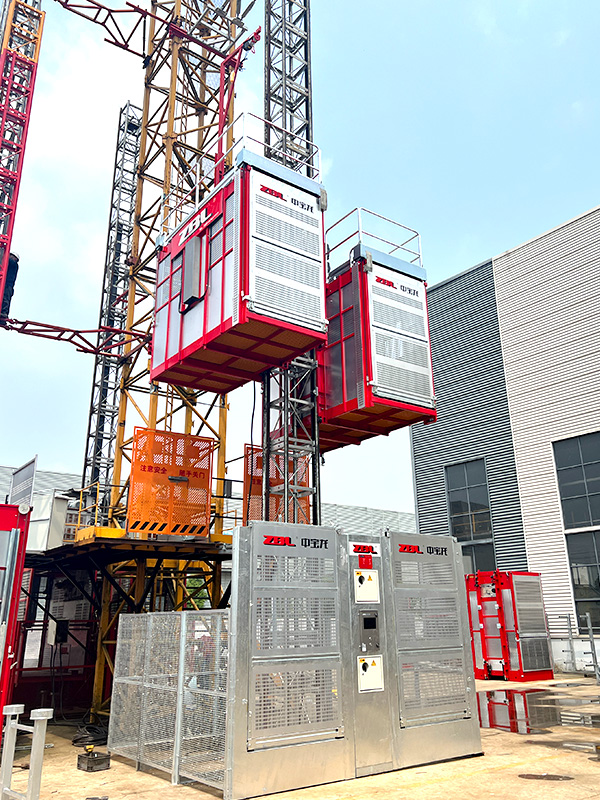
Two cages come down a tower at shift change, each walking a steel rack bolted to a lattice mast, stopping level with the landing in one unhurried motion. That motion is the rack and pinion drive: pinions geared to the cage meshing with a toothed rack fixed to every section of the mast.
The conclusion first: for anything above a few storeys, rack and pinion is not one option among several — it is the architecture the building industry standardized on, because it removes the two limits a rope can never escape, length and stretch, and gives the safety gear something solid to grip.
How a Rack and Pinion Construction Hoist Works
The drive train, in plain terms
Each cage carries a drive frame on its outer wall. On the frame sit two or three pinions whose teeth mesh with the rack running the full height of the mast; electric motors turn the pinions, and the cage walks up or down. The mast itself is assembled from standard sections roughly 1.5 m tall, bolted end to end and anchored to the structure at intervals the manufacturer's manual specifies. Because the drive pushes directly against gear teeth, the cage holds position with power off — no rope stretch, no drift.
Where the safety case comes from
Positive engagement cuts both ways, in a good sense. If a cage over-speeds, a centrifugal governor releases a safety device that clamps the rack itself, independent of the brakes. There is no counterweight to erect or maintain, which shortens installation and removes an entire category of rigging risk.
A rack never runs out. Hoisting height is set by the number of sections you bolt on — not by how much rope a drum can store. That single property is why the toothed mast became the default vertical transporter for buildings.
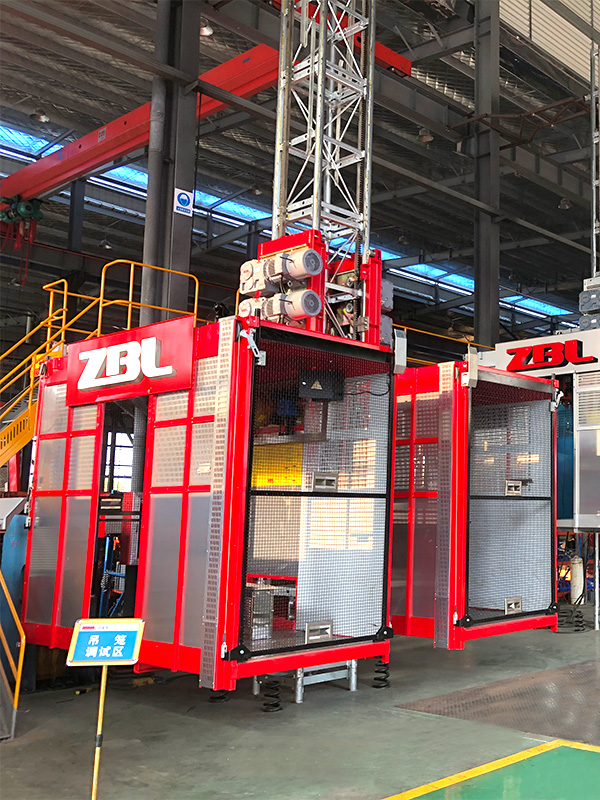
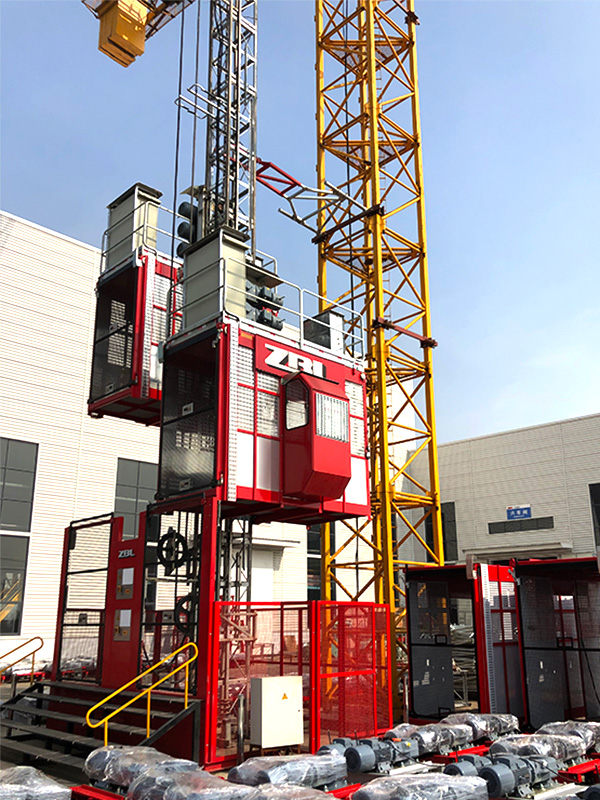
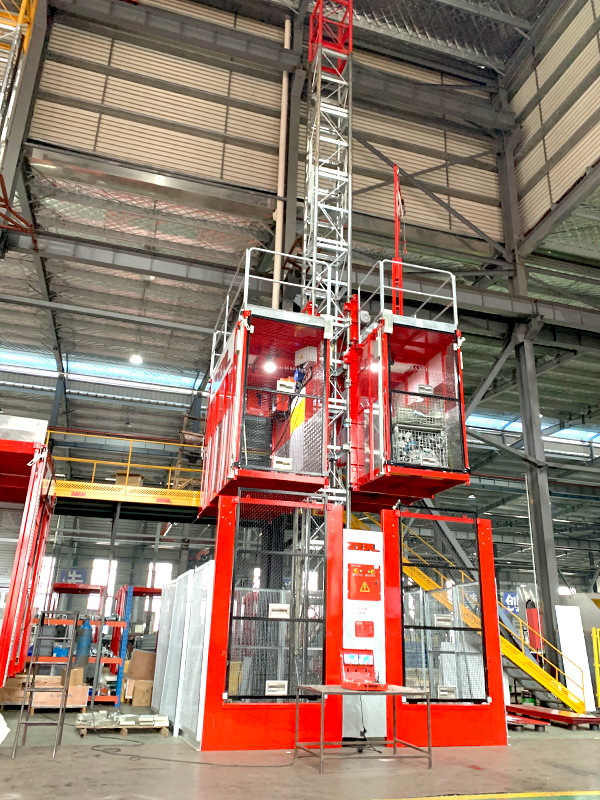
The SC200 platform, which much of the market treats as the baseline passenger and material machine, is built entirely around this arrangement — twin cages on one mast, each with its own drive and safety chain.
 SC200 Series Twin-Cage Construction HoistA twin-cage passenger and material hoist with a rack-and-pinion drive that avoids rope stretch and sway, keeping landings precise while the mast extends as the building grows.View Product →
Why Sites Keep Choosing the Toothed Mast
On a working site the deciding factors are unglamorous. Dust, rain and temperature swings punish exposed rope sheaves; gear teeth running under a drive cover tolerate them. Rope stretch and load sway disappear as failure modes, landings stay precise at every level, and when the structure grows, the mast grows with it — a few sections and tie-ins, not a re-roping job. The table below sets the two architectures side by side.
| Aspect | Rope-Suspended Drive | Rack and Pinion Drive |
|---|---|---|
| Maximum lift height | Limited by rope drum capacity and rope length | Limited by mast height; sections added as the building rises |
| Load behaviour | Rope stretch and sway vary with height and load | Fixed engagement; level stops independent of rope elasticity |
| Wind and dust | Exposed sheaves and grooves collect grit | Gear mesh protected beneath the drive frame cover |
| Safety engagement | Relies on brake and overspeed systems acting on the rope | Safety gear grips the rack directly, independent of brakes |
| Counterweight | Often required | Not required on most building hoists |
Rope-suspended platforms still earn their place on short-duration or facade work. But for months of mixed passenger and material transport on a rising structure, the rack and pinion hoist wins on height, on consistency, and on the simple mechanics of its safety system.
Specifying Speed, VFD Control and Cage Layout
Most building hoists fall into two speed bands. Fixed-speed machines cruise around 33–36 m/min, which suits short lifts and tight sites. Frequency-controlled drives accelerate from zero, cruise at 60 m/min and beyond on taller structures, and — just as importantly — soften starts and stops so the cage levels with the landing instead of jolting to it. On a twin-cage SC200/200 built with variable-frequency control, drives totaling around 37 kW per cage are a common specification for exactly this reason.
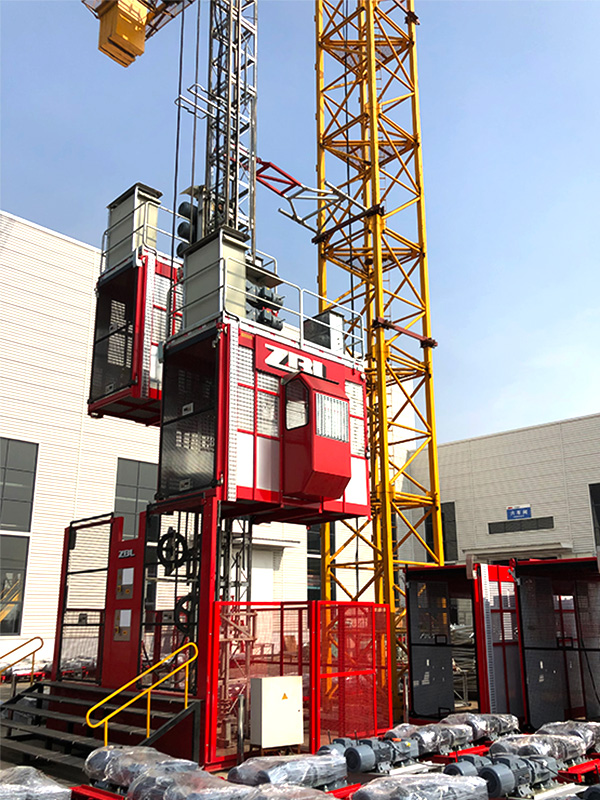 Variable Frequency Medium and High Speed Construction HoistFrequency-controlled SC200/200 hoists running from medium speeds up to around 96 m/min soften starts and stops for smooth leveling at landings on high-rise and super high-rise structures.View Product →
Info — When comparing variable-frequency offers, ask how the inverter is tuned for temporary site supply. Voltage on a construction network fluctuates; a drive that cannot ride those dips will trip exactly when the cage is full.
Cage specification is the other half of the decision. Large combination cages in the 4.83 × 2 m class carry palletized material alongside passengers where regulations allow; dedicated cargo machines such as the SCH100-100 series handle goods-only duty; and wall-mounted brackets, cage doors and landing gates are selected to match the structure rather than the other way around.
Where the Drive Earns Its Keep on Real Projects
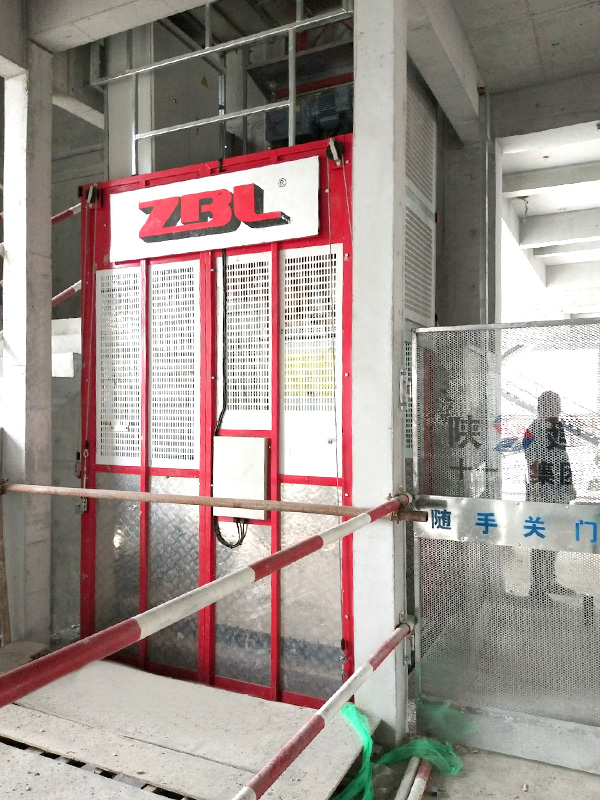
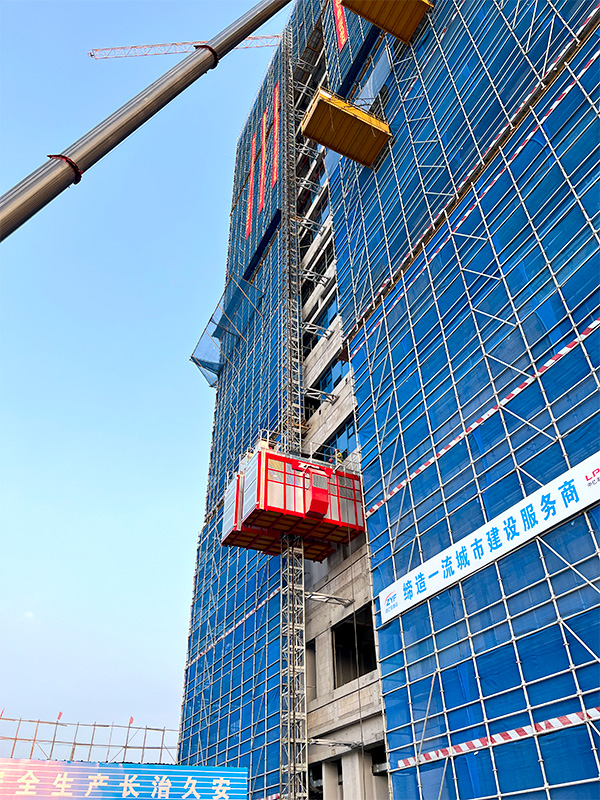
The same drive now serves residential towers and resettlement housing, cultural buildings such as theatres where facade geometry forces wall-mounted configurations, and dense new-town cores where hoists share a constrained plot with cranes and site logistics. Suppliers working in power, bridge and mining projects push the same principle into harsher environments.
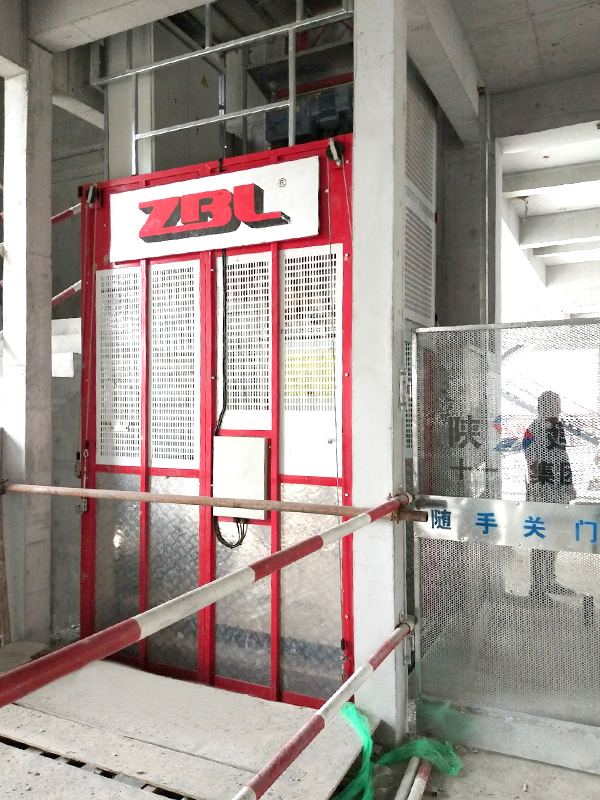
It also extends into automation. The intelligent unmanned well-shaft hoist deployed on the Xi'an Caojiatan Innovation Center project runs the same rack-and-pinion principle with no operator on board — possible because gear engagement gives the control system a position it can trust to the centimetre.
Wear Points: Racks, Pinions and the Safety Chain
A gear mesh is a wear interface, and on a hoist it works hard — loaded starts, contaminated teeth, years of cycles. The items that decide long-term reliability are short and worth knowing by heart:
- Pinion teeth, checked with a wear gauge against the limits in the manual
- Rack tooth flanks and the bolted joints between mast sections
- Safety-gear pinion and governor linkage, kept clean and functional
- Drive-frame rollers and bearings, which carry the lateral load
- Brake pads, verified by the daily brake check
Danger — If the overspeed safety device has tripped, do not restart the hoist until qualified personnel have inspected and reset it. The device performed exactly as designed; the inspection proves the system still can.
Warning — A worn pinion does not simply fail itself; it chews the rack it runs on. Pinions and rollers are inexpensive relative to the damage they cause when ignored.
The routine itself is not complicated: daily brake checks, lubrication of the mesh, torque checks on mast bolts, and wear-gauge readings logged on a schedule. The daily and weekly steps are set out in this guide to construction hoist maintenance and upkeep.
Success — Sites that log pinion and rack readings monthly, and test the safety gear at the intervals the manual requires, rarely see an unplanned hoist stop. The logbook is the maintenance.
When drive components do reach their limits, replacements should come as matched assemblies rather than improvisation — a transmission mechanism selected for the specific cage and motor combination keeps the mesh within specification.
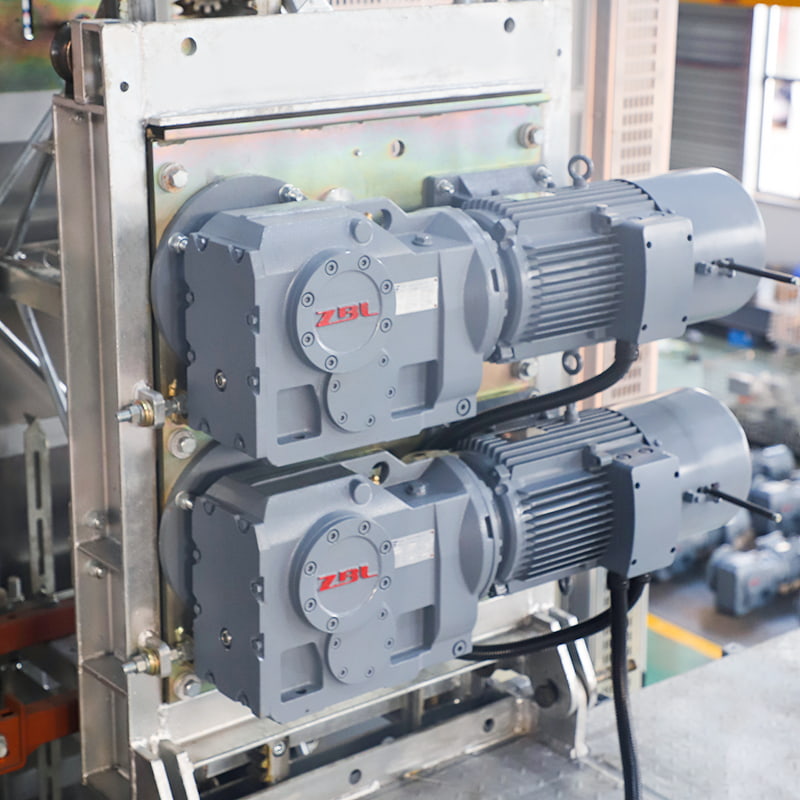 Construction Hoist Transmission Mechanism OptionsWorm or helical gear and bevel gearboxes matched to the cage and motor, in two-drive or three-drive configurations, keep the gear mesh within specification when drive parts need replacement.View Product →
What to Check Before You Choose a Manufacturer
Because the drive is simple, quality lives in tolerances and process. Five checks separate a hoist that runs for seasons from one that spends them in the repair bay:
- Rack machining and heat treatment, plus joint accuracy between sections
- Automated welding on cage frames and mast components, where consistency matters
- Blast-and-paint lines that control corrosion before assembly, not after
- An in-house inspection and testing centre with authority to stop a batch
- Installation crews, spare-parts supply and after-sales response covering the project's region
Jiangsu Zhongbaolong, a construction hoist manufacturer in Dongtai, Jiangsu, illustrates the profile: laser cutting and CNC bending feed robot welding stations, an automatic surface-treatment and painting line precedes assembly, and a dedicated inspection centre sits behind them. The company supplies SC-series machines with installation, rental and after-sales service across projects in Xi'an and the Yangtze delta cities.
Ask the drive-train questions first — rack quality, pinion replacement policy, safety-gear testing, VFD tuning — and let the price follow. A construction hoist is, at its core, a rack and pinion that has been machined, welded and maintained properly; everything else on the mast is detail.
