



Please leave your email address, So that we can get in touch with you as soon as possible.
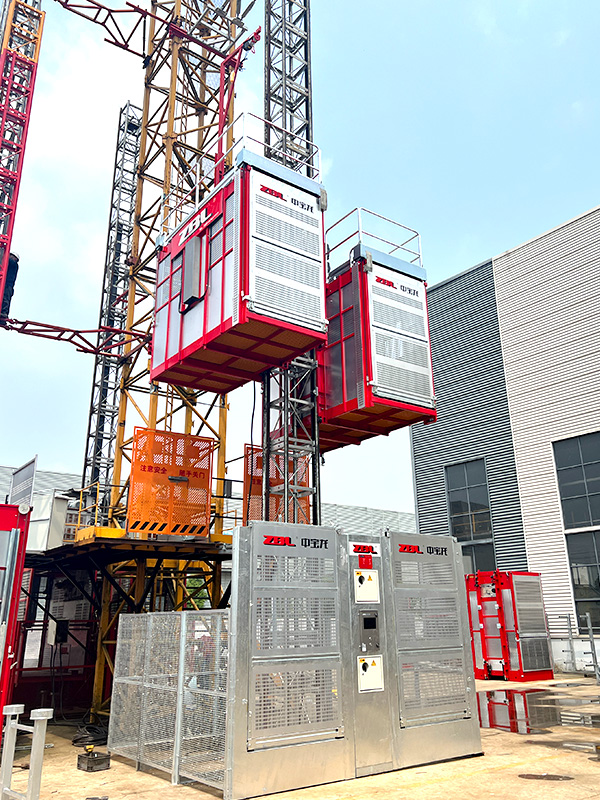
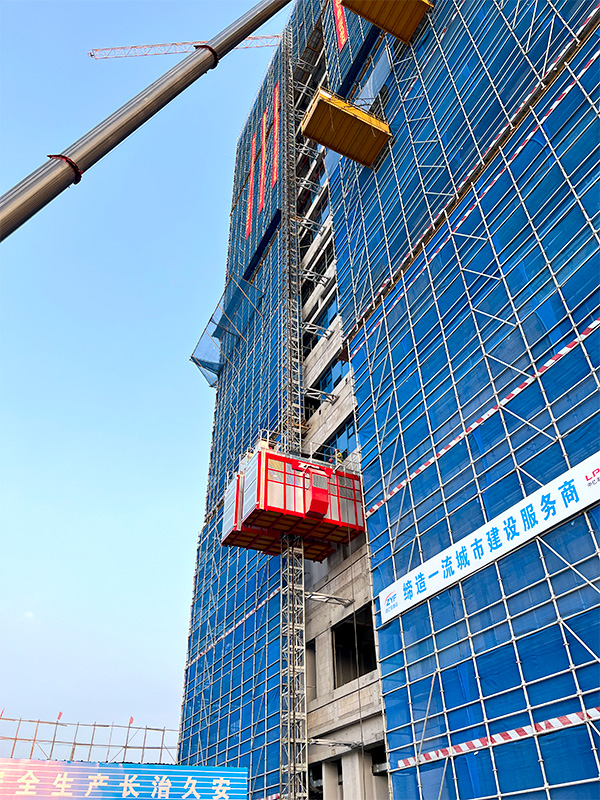
On a 28-story residential tower, the construction hoist is the one machine that touches every trade on site. Masonry blocks, drywall, tile, and the crews who install them all travel through the same cage. When the hoist design is right, the building's vertical rhythm feels effortless. When it is wrong, the price appears as queue time, overtime, and avoidable safety risks. Construction hoist design is not a catalog exercise at the end of procurement. It shapes build speed, worker safety, and the total cost of vertical transport from first pour to final fit-out.
Start with the Transport Brief, Not the Machine
The most common mistake in selecting a construction hoist is starting from a model number. The right starting point is a transport brief: what the machine will carry, how often, over what height, and under which site constraints.
A practical brief answers at least these questions:
- Peak-hour worker count: how many people must reach the upper floors in the busiest 60 minutes of a shift?
- Material payload profile: lightweight finishes, dense masonry packs, or bulky prefabricated components?
- Building height: what is the highest landing, and how many mast sections does that require?
- Site conditions: is there room for a free-standing base, or must the hoist tie into the structure early?
- Project phasing: will the same unit serve structural works and then fit-out?
These answers become design parameters. A tower with heavy precast panels needs a higher rated load and a stouter drive train. A narrow city-centre plot may favor a wall-mounted cage that keeps the ground footprint small. A fast-track high-rise justifies a variable-frequency medium- or high-speed machine, because the cycle-time saving across 30 floors is measured in hours per day, not minutes.
| Transport brief input | Primary hoist design response | Practical impact |
|---|---|---|
| Peak shift of 40+ workers | Larger cage or twin-cage layout | Shorter ground-level queues |
| Height above 60 m | Variable-frequency medium/high-speed drive | Faster cycle, fewer hoists needed |
| Heavy material payload | Higher rated load, reinforced rack | Better safety margin on dense loads |
| Narrow site footprint | Wall-mounted cage option | Hoist fits within the site boundary |
| Long rental period | Modular mast, accessible service points | Lower maintenance cost and downtime |
Mast, Rack, and the Rigidity Question
The mast is the vertical spine of the hoist. It determines how accurately the cage travels, how the machine behaves in wind, and how long the rack-and-pinion system lasts before wear shows.
In a rack-and-pinion hoist, the pinion on the drive unit engages the rack fixed along the mast. Every load cycle passes through that contact. If the mast deflects beyond design assumptions, pinion pressure becomes uneven, the cage sways, and wear accelerates.
A hoist is only as straight as the mast it runs on. Alignment, rigidity, and load path are design decisions, not maintenance items.
The parameters that matter most:
- Mast section dimensions, steel grade, and joint tolerances between sections.
- Wall-tie spacing between mast and structure; six to nine meters is common, but wind and height can demand less.
- Foundation and base-enclosure design: a hoist is only as straight as the surface it stands on.
Wind is the hardest condition. Above 100 meters, static pressure and gust effects deflect the mast, so calculations must balance the building's shielding against the exposed face where the hoist runs.
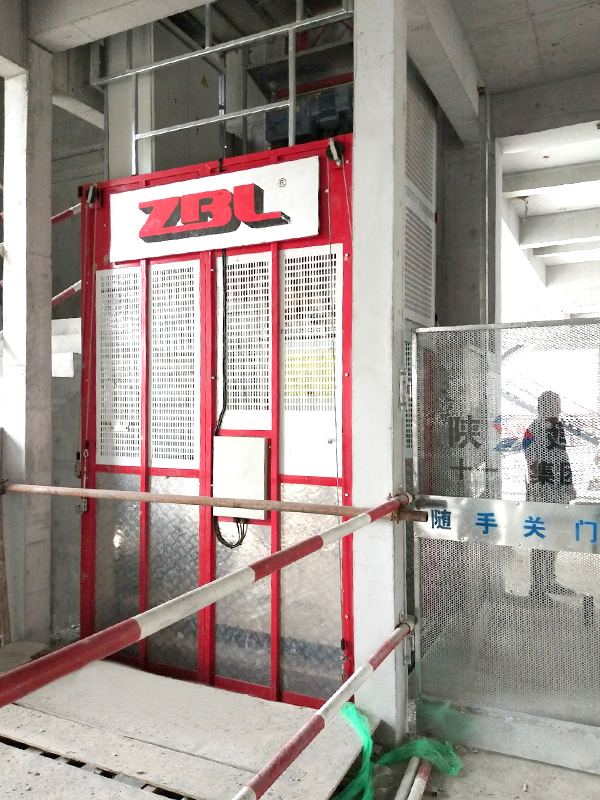 SC200 Series Construction Hoist for High-Rise UseBuilt around proven mast geometry and flexible wall-tie options, this hoist suits residential and commercial towers where wind loading and structural stability require a dependable lifting solution.View Product →
The SC200 series is a practical example of these structural requirements in production: proven mast-section geometry, multiple wall-tie configurations, and rated loads suited to typical residential and commercial towers.
Drive Systems and Speed: The Pulse of Vertical Transport
The drive system converts electrical power into smooth vertical motion, and it separates a slow, robust material hoist from a fast passenger-and-material hoist.
Two design directions dominate:
- Low-speed, high-torque cargo configurations move heavy loads dependably at modest speeds, with simpler electrical systems and lower energy use per trip. They suit projects where cycle time is secondary.
- Variable-frequency medium- and high-speed configurations suit tall buildings: controlled acceleration and deceleration, accurate floor landing, and speed curves tuned to the site. On a 40-floor structure, the time saved can mean one hoist instead of two.
A VFD also softens the mechanical shock on the rack-and-pinion drive during start-up and stopping, which extends component life. The principle behind variable-frequency speed regulation is simple: instead of fixing motor speed at the mains frequency, the drive varies frequency and voltage to match load and speed.
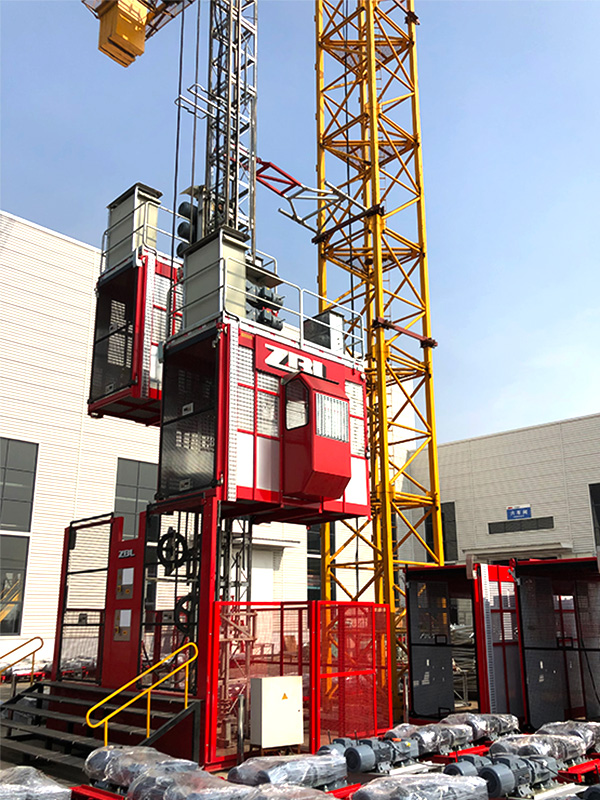 Variable Frequency Medium and High Speed Construction HoistWith speeds up to 96 m/min and multi-drive configurations, this model addresses torque behavior and efficiency for projects where the same hoist handles people and dense materials at different times.View Product →
Where the same hoist carries people by day and denser materials at night, torque behavior matters as much as maximum speed.
Warning A faster drive does not replace structural or safety margins. Higher speed shortens cycle times, but the mast, landing gates, and operator discipline must keep pace.
Safety Systems Are Designed In, Not Bolted On
Hoist safety is a chain of independent layers, and each layer affects how the others are designed.
- Overspeed governor and mechanical safety gear: an independent system that grips the mast rack if the cage exceeds descent speed. Braking distance must stay predictable for empty and fully loaded cages.
- Top and bottom limit switches cut drive power before the cage reaches the end of mast travel.
- Door interlocks prevent cage movement unless the cage and landing doors are closed.
- Base buffers absorb residual energy if the cage travels past its lower limit.
- Overload protection blocks lifts beyond rated capacity.
- Emergency descent brings the cage down during a power failure or drive fault.
Design quality shows in how these systems work together. The governor must match the rated speed and load; limit switches need clearance margins; overload protection must tolerate starting current without nuisance trips.
Danger Never run a hoist with a disabled safety device. When schedules slip, bypassing interlocks or overload warnings is tempting. Good design makes the correct operation the easiest path and makes tampering visible to supervisors.
Intelligent Hoists: Design Meets Site Data
The clearest shift in construction hoist design is the move from isolated machinery to connected, software-aware systems. An intelligent hoist does not only lift; it records. Automatic floor selection, operator identification, remote monitoring, and fault logging change how the site manages vertical transport.
For a project manager, that means fewer dedicated operators, more disciplined traffic, and an evidence trail for condition-based maintenance rather than fixed-interval guesswork.
Info When evaluating an intelligent hoist, ask how data is stored and who can act on it. Reports nobody reads are no better than extra sensors.
Interface design matters as much as hardware. On a dusty, noisy site, controls must stay legible through gloves and fatigue, and responses must be consistent from the first operator to the last.
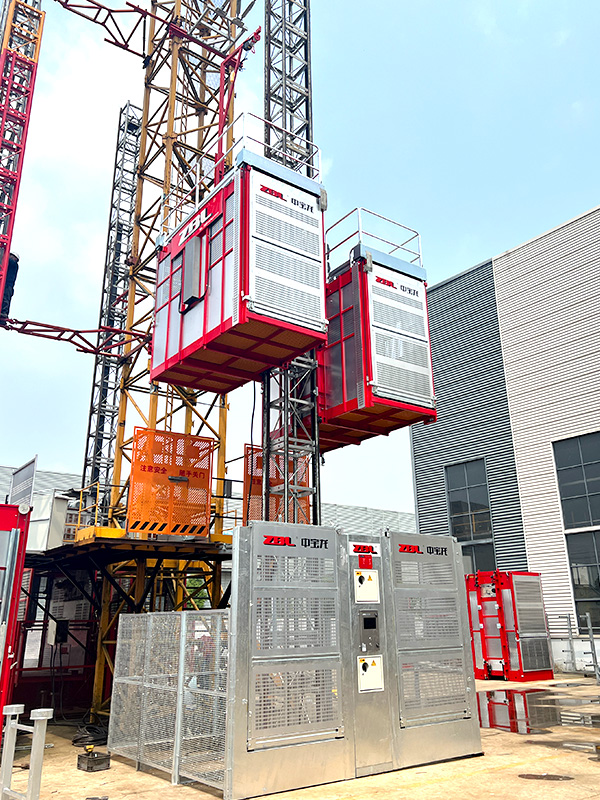 SC200/200ZN Intelligent Construction HoistDesigned for smart site operation, this hoist offers real-time monitoring, safe handling, and no full-time driver needed, as demonstrated in the Xi'an Caojiatan innovation centre project.View Product →
Intelligent models such as the SC200-200ZN already work in tower logistics, including at the Xi'an Caojiatan innovation centre project, where vehicle-free well ladders moved from prototype conversation to site practice.
Design for Installation, Maintenance, and a Decade of Use
A construction hoist is assembled, climbed, extended, and dismantled, sometimes several times in one project. The decisions that make those operations fast and safe are usually the ones that keep total cost of ownership low.
- Modular mast sections with solid bolted joints shorten climbing and cut crane time.
- Standard rack pitches and pinion dimensions simplify spare-part stocking.
- Weather-protected motors, corrosion-resistant paint, and sealed electrical cabinets extend life in coastal or dusty regions.
- Cable-guiding sections keep the trailing cable clear of scaffolding and moving parts; cable failure is a leading cause of unplanned stops.
An installation-friendly hoist can be operational within days. A service-friendly hoist cuts each maintenance visit by hours, and on a multi-year project those hours compound.
Success A hoist matched to its transport brief, protected by integrated safety layers, and easy to service will outperform a larger, faster machine specified without context.
Construction hoist design comes down to matching the machine to the building, the site, and the people who rely on it every shift. The right start is the transport brief. The right outcome is a hoist whose structural margins, drive performance, safety redundancy, and serviceability carry that brief for the entire project. When those choices are made early, vertical transport stops being a bottleneck and becomes an asset.
