



Please leave your email address, So that we can get in touch with you as soon as possible.
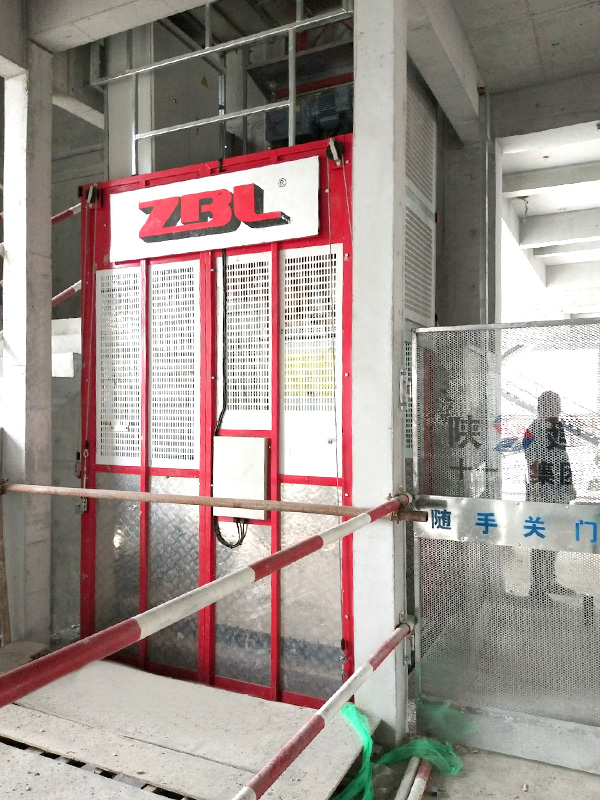
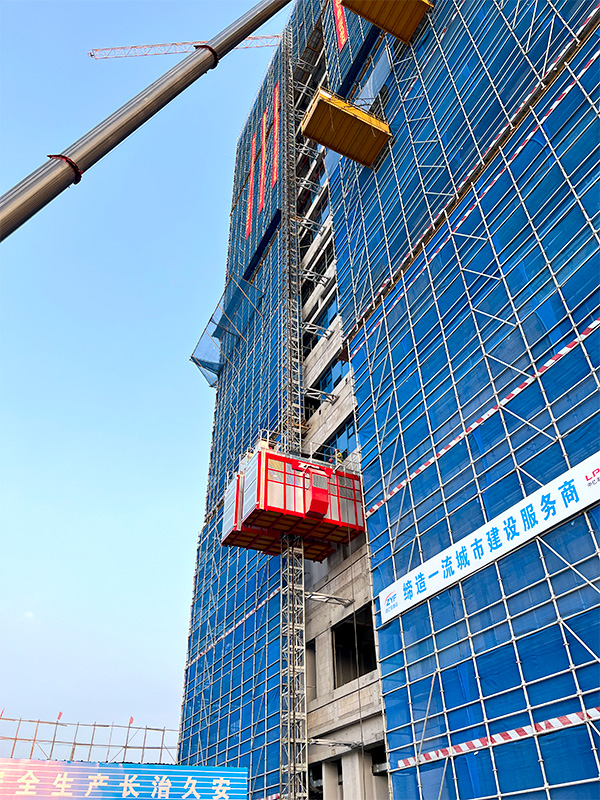
A residential tower in Xi'an needs roughly 180 tonnes of finishing material lifted above the tenth floor before handover. The temporary hoist that moves it is usually the last major item priced and the first piece of equipment blamed when a slab falls behind schedule. That gap between how hoists are bought and how they are judged on site runs through the entire construction elevator market.
Published forecasts place global demand somewhere between USD 1.7 billion and USD 2.3 billion, expanding at a mid-single-digit rate each year. The spread between those figures is far narrower than the spread between two quotes for what looks like the same machine.
The Short Answer Before the Spreadsheets Open
The construction elevator market is growing steadily rather than dramatically, and a large share of that growth is absorbed by replacement and upgrade demand in mature cities rather than by new high-rise starts alone. For a contractor, a rental fleet operator or a developer, the headline market figure is therefore close to useless as a purchasing input.
What actually decides a hoist purchase is local. Building height and the daily load profile set the required rated capacity. The site's power arrangement decides whether a variable-frequency drive earns its price premium. The distance to spare parts and service capability sets the real cost of a two-day stoppage. Across the project types that dominate order books, including resettlement housing, commercial complexes, theatres, innovation parks and city-new-area cores, those three variables differ enough that the same model rarely wins twice for the same reason.
What the Published Market Numbers Actually Agree On
Three studies released between 2025 and 2026 are quoted most often in tenders and feasibility notes. Read side by side, they are more useful than any single one.
| Published estimate | Base value | Forecast value | Stated growth |
|---|---|---|---|
| Global construction elevators study | USD 1.95 billion (2025) | Not published | About 4% a year |
| Construction lift market report | USD 2.27 billion (2024) | USD 4.64 billion (2035) | 6.72% CAGR |
| Construction elevators outlook | USD 1.72 billion (2025) | USD 3.22 billion (2034) | 7.2% CAGR |
The disagreement is mostly definitional. One study treats construction elevators as a stand-alone equipment category, another folds adjacent material-handling equipment into a broader label, and a third adjusts for base year and currency. What they share matters more than what separates them: none of them describes a market that will run short of capacity, which means availability stops being a differentiator and specification quality takes its place.
Why Two Quotes for the Same Hoist Rarely Match
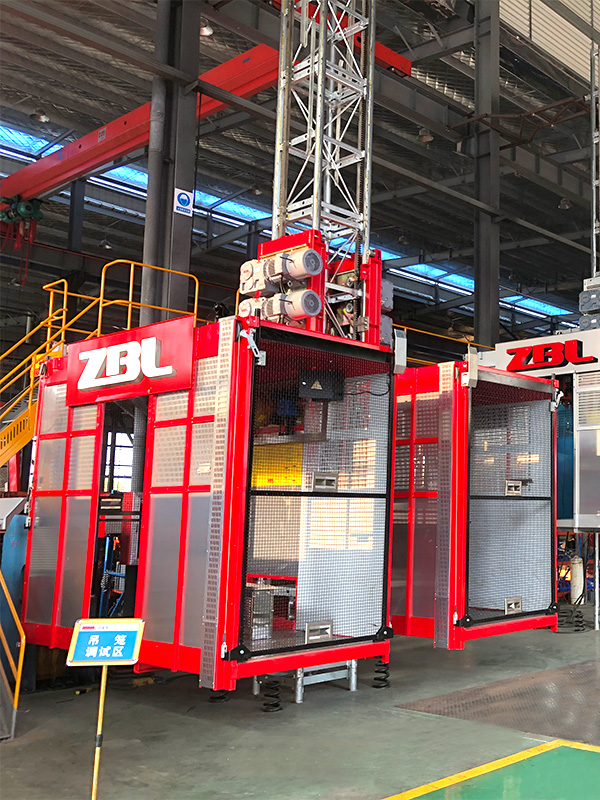
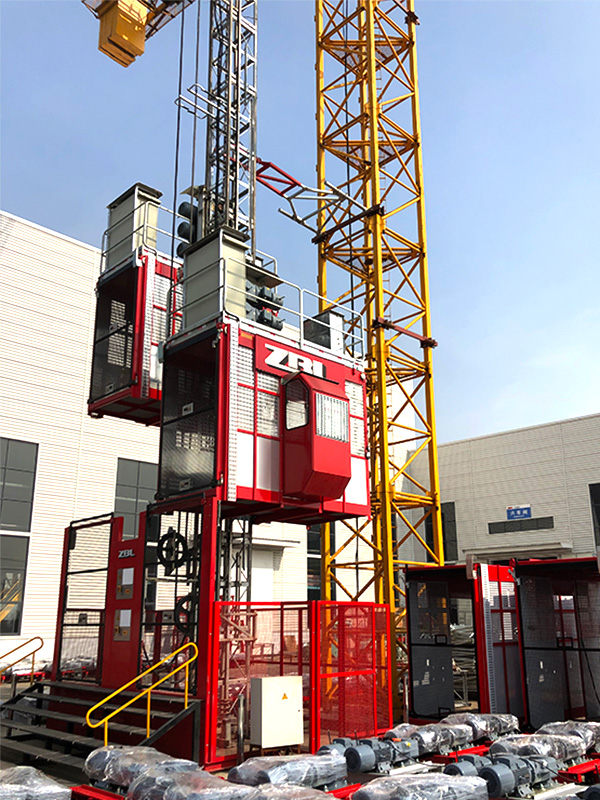
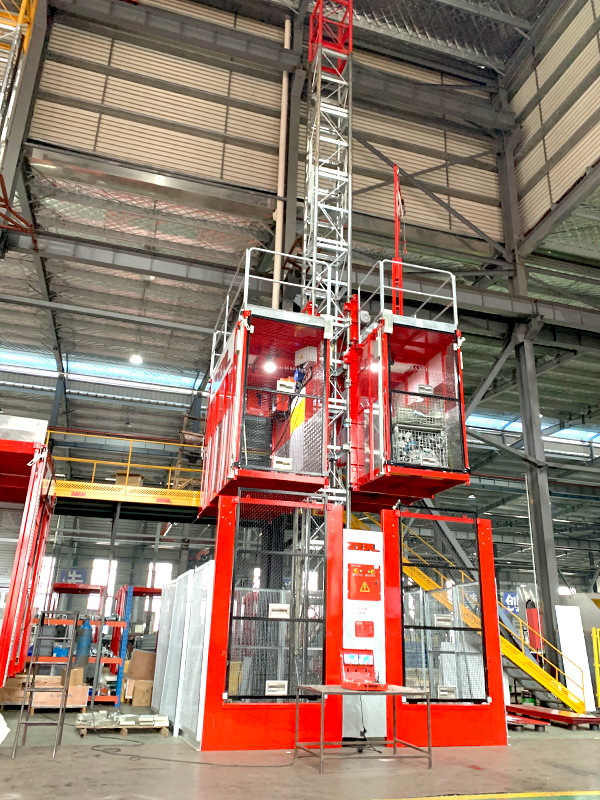
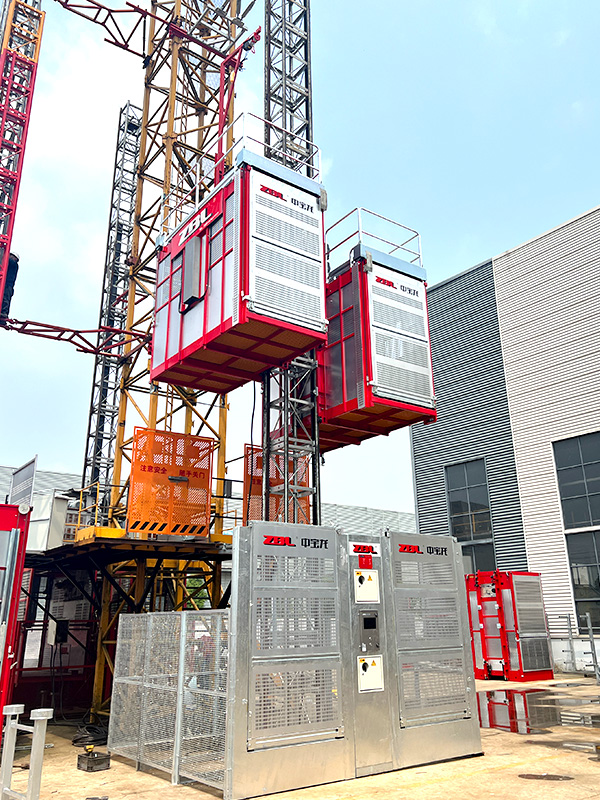
Two suppliers can quote the same nominal model and still deliver two different machines. A single platform shows how that happens. The SC200 family is split first by drive and speed into a variable-frequency low-speed unit and a variable-frequency mid-to-high-speed unit, then divided again by duty into an intelligent model and a cargo-rated series built around a different cage and frame logic.
Beyond the machine itself, an order normally carries a mast section quantity, a cage door selection, a wall-mounted option for tight sites, a transmission configuration and a cable guiding section. Each decision changes cost, cycle time and the spare parts that have to be held on site or nearby. A comparison that ignores them is not a price comparison at all; it is a comparison of two different scopes of supply.
Three Numbers That Decide the Right Machine
Three figures settle most specification arguments, and none of them is the purchase price.
- Rated load. The SC200 designation carries a nominal two-tonne payload per cage, which suits mixed passenger and material duty on residential and commercial frames. Cargo-focused work often justifies a different duty class where throughput, not ride quality, is the constraint.
- Hoisting speed. Low-speed variable-frequency machines prioritise smooth starting and stopping, which reduces load swing and structural shock. Mid-to-high-speed machines cut cycle time on tall frames, but only pay back when the crane and placing crews can keep pace.
- Cage footprint. Long panels, formwork bundles and prefabricated bathroom pods need a wider platform. Combination assembly cages built on a larger footprint exist for those loads, and they change mast and tie-in requirements as well.
Where a project moves materials far more often than people, a cargo-rated variable-frequency machine can replace a passenger-class unit without losing usable capacity, and it usually simplifies the inspection and operating regime on site.
Automation, Sensors, and the Intelligent Hoist Question
Intelligent hoists are not a marketing overlay. They change how the machine is operated, monitored and handed over between shifts. On a large frame with several work fronts, the difference between a conventional unit and an intelligent one shows up in call handling, landing accuracy and fault logging rather than in lifting capacity.
The clearest evidence is project-level. An intelligent unmanned well-ladder installation at the Caojiatan innovation centre project in Xi'an points in that direction: fewer operators in the car, more supervision from the ground, and a shorter handover between the structural and finishing phases.
Buyers should still treat intelligence as a specification line with its own evaluation criteria: which functions are automatic, what happens when the network drops, and who can service the control system within the warranty window.
Site Conditions That Break a Purchase Decision
Most hoist failures that reach a project's risk register are not manufacturing failures. They are interface failures. High-altitude and low-oxygen sites change both human performance and equipment derating. Extreme temperature swings load the cage door mechanism, the seals and the control cabinet. Sites with unstable power or frequent outages lose more time to drive faults than to mechanical wear.
A machine specified for a 100 m lift, installed on a frame with a 60 m power run and no spare drive on site, will not fail because of the market. It will fail at the interface, and it will do so during the week the finishing trades are waiting.
Two practical responses shorten that risk. The first is to write the electrical and environmental envelope into the purchase specification instead of assuming it. The second is to treat maintenance and upkeep routines as a delivered item with named responsibilities, not as a site habit that appears once the machine starts running.
Warning: a spare drive unit and a trained on-site technician change the mean time to recovery more than any single upgrade to the machine. If the quotation does not state who holds both, the quotation is incomplete.
Regional Demand Signals Worth Watching
Regional demand is not uniform, and the differences are operational rather than statistical.
- China. Large resettlement and city-new-area programmes keep multi-machine projects common, rewarding suppliers who can support several sites at once.
- India. Rapid high-rise construction in tier-one and tier-two cities keeps demand for mid-range, serviceable units steady.
- United States and Germany. Replacement and compliance-driven purchases dominate over new capacity, so documentation quality carries more weight than price.
- Brazil and South Korea. Mixed cycles, with infrastructure and industrial work providing the steadier slice of demand.
- Japan. An ageing equipment stock and strict site-safety expectations favour machines with clear inspection records and parts continuity.
Note: for a single project, the useful regional question is not how fast the market is growing but how close the nearest stocked parts position is. That distance, not the growth rate, sets recovery time.
A Practical Checklist Before You Approve a Quote
- Convert every offer to one configuration sheet: drive type, speed class, rated load, cage dimensions and mast quantity.
- Ask for the electrical envelope in writing, including voltage tolerance and behaviour during an outage.
- Confirm which optional components are included, from the cage door variant to wall mounting, transmission arrangement and cable guiding.
- Check the parts and service commitment against the project's peak programme, not its average month.
- Price inspection, operator training and handover documentation as separate lines.
- Require a stated mean time to recovery, with named responsibility on both sides.
The construction elevator market will keep growing at a rate that rewards planning rather than urgency. The machines that perform well on a given site, however, will keep being chosen the same way they always have: by matching load, speed and cage to the building, by writing the electrical and environmental envelope into the order, and by deciding early who holds the spare parts. None of those decisions depends on the forecast. All of them decide whether the hoist is remembered as equipment or as the reason the finishing trades were late.
