



Please leave your email address, So that we can get in touch with you as soon as possible.
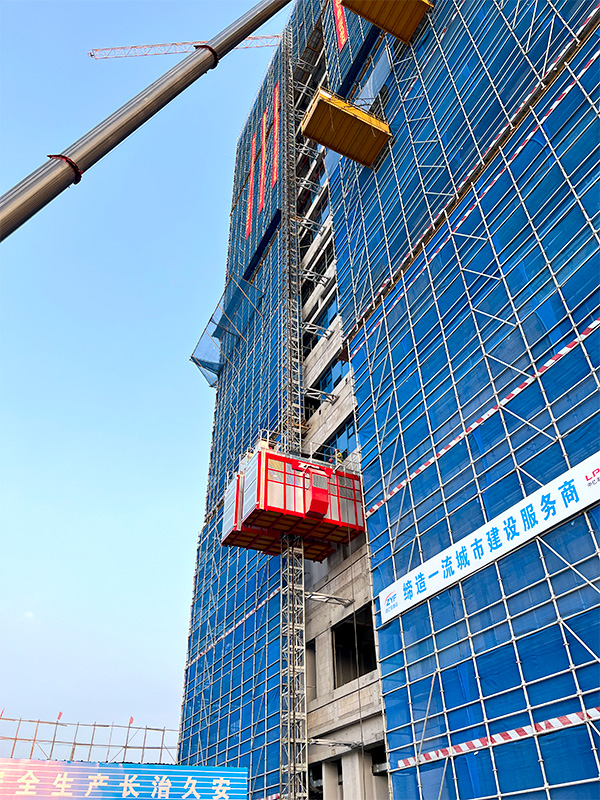
Most modern rack-and-pinion construction hoists support a dual-cage configuration, and the impact on throughput efficiency for high-rise projects is substantial. A dual-cage construction hoist operating at 63 m/min can transport approximately 100–120 persons per hour per direction, compared to roughly 55–65 persons per hour for a single-cage unit of equivalent speed. For high-rise projects with 300 or more workers on site, this difference is not marginal — it directly determines shift start and end productivity, material delivery cycle times, and overall construction program duration. Understanding how dual-cage systems work, when they are justified, and how to optimize their operation is essential knowledge for any project manager or hoist procurement specialist.
How a Dual-Cage Construction Hoist Configuration Works
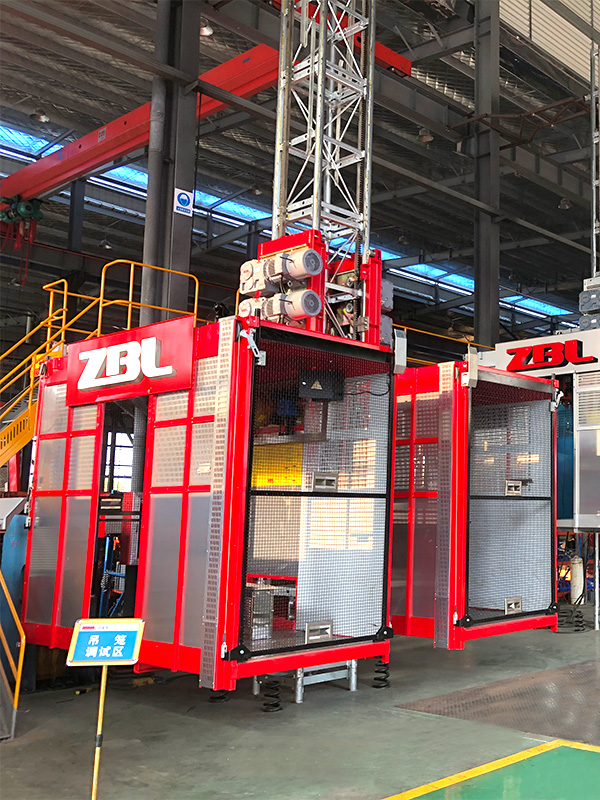
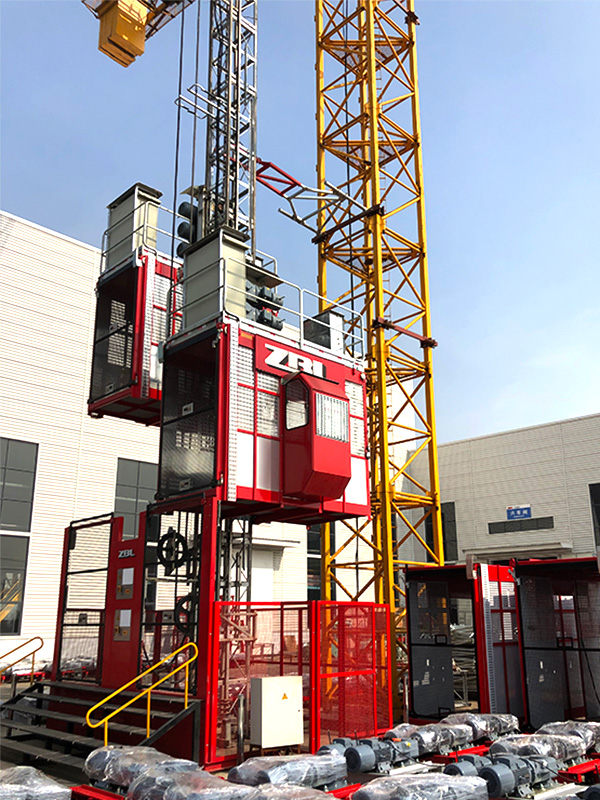
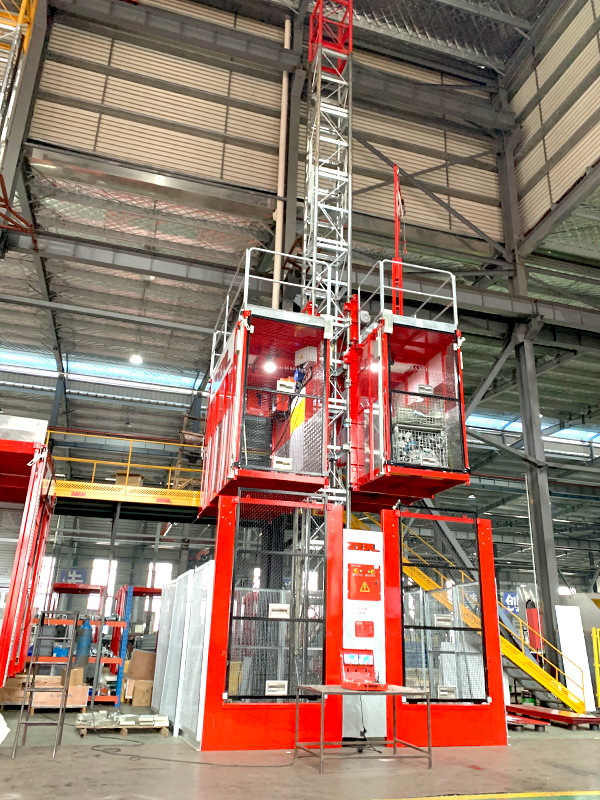
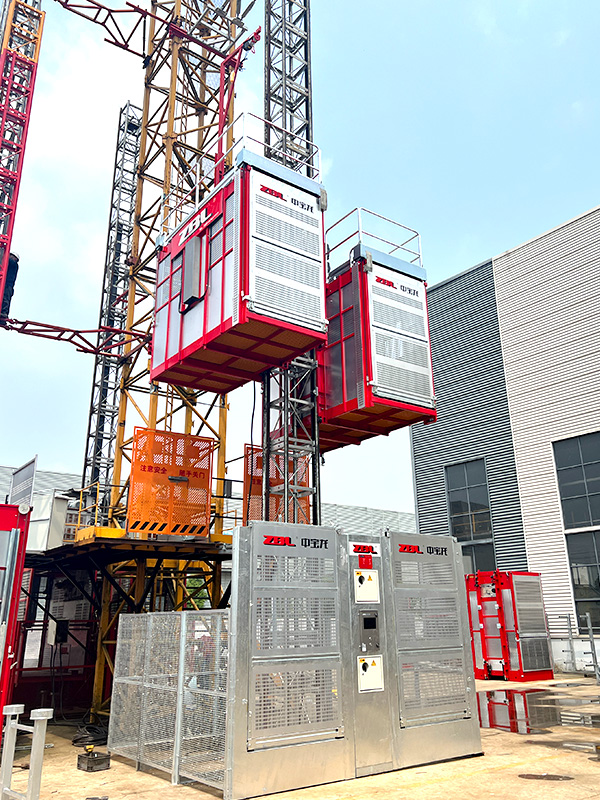
In a dual-cage construction hoist, two independent cages are mounted on the same mast structure, each driven by its own motor and pinion gear set, operating on the same rack. The two cages travel on separate guide rail tracks — typically positioned back-to-back or side-by-side depending on the mast frame design — and are controlled by an interlocked system that prevents collision.
Key mechanical characteristics of dual-cage construction hoist systems include:
- Each cage operates independently with its own drive motor, brake system, and safety gear
- Anti-collision logic is embedded in the control system, typically enforcing a minimum 2-mast-section (3.2 m) separationbetween the two cages at all times
- Both cages share the same mast, base frame, and tie anchor points, reducing installation footprint compared to two separate single-cage units
- Standard cage dimensions for dual-cage models are typically 2 m × 1.5 m × 2.5 m (L × W × H), with load capacities of 2,000–3,200 kg per cage
- The combined mast tie loads are higher than for a single-cage unit, requiring structural engineer verification of anchor capacity
The two cages can be dispatched independently — one ascending while the other descends — maximizing utilization of the mast at any given moment. This counterflow operation is the primary source of the throughput gains that make dual-cage construction hoists the standard choice on high-rise projects globally.
Throughput Efficiency: Dual-Cage vs Single-Cage Performance Data
The throughput advantage of a dual-cage construction hoist becomes most pronounced as building height increases, because cycle time — the time for one complete round trip — grows with height and dominates single-cage capacity. The following table illustrates the comparative throughput under typical operating conditions, assuming a cage capacity of 24 persons, a lifting speed of 63 m/min, and a 15-second dwell time per landing stop.
|
Table 1: Estimated personnel throughput comparison between single-cage and dual-cage construction hoists at various building heights (63 m/min, 24-person cage, 15s dwell time per stop). |
|||
|
Building Height |
Single-Cage Persons/Hour |
Dual-Cage Persons/Hour |
Throughput Increase |
|
50 m (approx. 15 floors) |
~96 |
~175 |
+82% |
|
100 m (approx. 30 floors) |
~65 |
~120 |
+85% |
|
200 m (approx. 60 floors) |
~40 |
~76 |
+90% |
|
300 m (approx. 90 floors) |
~28 |
~54 |
+93%
|
The data reveals a consistent pattern: as height increases, the throughput advantage of the dual-cage construction hoist approaches a factor of 2× (near-doubling). This is the mathematical consequence of the independent counterflow operation — while one cage is descending empty, the other is ascending loaded, eliminating the idle return time that cripples single-cage throughput at height.
Real-World Impact on High-Rise Construction Program Schedules
The throughput figures translate directly into program schedule outcomes. Consider a 60-floor residential tower with 400 workers on site during peak construction phase, requiring two shift changes per day (shift start and end), plus continuous material hoisting throughout the shift.
Shift Change Duration: Single-Cage vs Dual-Cage
With a single-cage construction hoist at 200 m height (40 persons/hour effective throughput), mobilizing 400 workers to their floors at shift start would require approximately 10 hours of dedicated hoisting — clearly unworkable within a standard shift structure. Even accounting for multiple hoists on site, a dual-cage unit at 76 persons/hour reduces the equivalent mobilization time by nearly half, making shift turnover in under 30 minutes achievable with two dual-cage construction hoists operating simultaneously.
Material Hoisting Cycle Times
Beyond personnel transport, the dual-cage construction hoist improves material logistics by enabling one cage to be dedicated to materials while the other handles personnel — a common operational strategy on large high-rise sites. On a typical reinforced concrete tower, the structural frame team may require 15–20 concrete pump hose sections, formwork panels, and rebar bundles delivered to the active floor per shift. With dedicated material hoisting on one cage, these deliveries do not compete with worker transport, eliminating one of the most common causes of productivity loss on single-hoist sites.
Structural and Installation Implications of Dual-Cage Configuration
Specifying a dual-cage construction hoist requires careful attention to several structural and installation factors that differ significantly from single-cage deployment.
- Base frame footprint:Dual-cage mast base frames are wider, typically requiring a clear ground area of 0 m × 3.5 m minimum versus 2.5 m × 3.0 m for single-cage units. Ground bearing pressure requirements increase proportionally and must be verified by a geotechnical assessment.
- Mast tie loads:With two cages operating simultaneously under combined wind and live load conditions, mast tie anchor forces can be 40–60% higher than single-cage equivalents. Each tie anchor must be independently assessed by a structural engineer against the building structure's capacity at that level.
- Power supply:A dual-cage construction hoist with two independent 3× 15 kW drive motors requires a dedicated 400V / 3-phase supply rated at 80–100 A minimum, with correctly sized cable runs from the site distribution board — often a critical path item in early site mobilization planning.
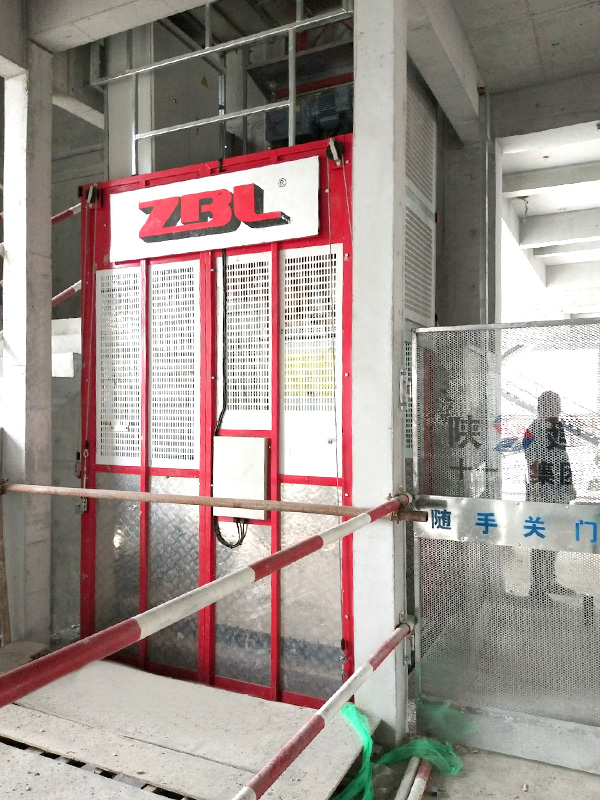
- Landing gate design:Each floor landing must accommodate two gate openings — one per cage — which requires careful coordination with the building's floor slab edge protection and temporary works design.
- Erection time:Installing a dual-cage construction hoist typically takes 2–3 days longer than a single-cage unit for initial erection, though mast climbing thereafter follows the same per-section time regardless of cage configuration.
When a Dual-Cage Construction Hoist Is and Is Not Justified
The decision to specify a dual-cage construction hoist should be driven by a quantitative assessment of site workforce size, building height, program duration, and logistics demand — not by a default assumption that bigger is always better. The following framework provides clear guidance:
|
Table 2: Decision framework for selecting single-cage versus dual-cage construction hoist configuration based on project parameters. |
||
|
Project Scenario |
Recommended Configuration |
Rationale |
|
Under 20 floors, fewer than 150 workers |
Single-cage |
Cycle times short enough; dual-cage investment not recovered |
|
20–40 floors, 150–300 workers |
Dual-cage or two single-cage units |
Borderline — assess shift change duration and material demand |
|
40+ floors, 300+ workers |
Dual-cage (mandatory) |
Single-cage throughput insufficient; program risk unacceptable |
|
Material-only hoisting, any height |
Single-cage (typically) |
Material scheduling can absorb longer cycle times; lower cost
|
Operational Best Practices to Maximize Dual-Cage Throughput
Specifying a dual-cage construction hoist is only the first step. Realizing the full throughput potential in daily operations requires deliberate management of dispatch protocols, loading discipline, and maintenance scheduling.
- Designate one cage for personnel and one for materialsduring peak shift hours (first and last 90 minutes of each shift). This eliminates queue conflicts and maximizes utilization of both cages simultaneously.
- Implement a floor-zoning dispatch system— assign Cage A to serve floors 1–30 and Cage B to serve floors 31–60 during peak periods. This reduces average travel distance per trip and increases cycle frequency by up to 25%.
- Schedule preventive maintenance on alternating cagesso that at least one cage remains operational at all times. A dual-cage construction hoist should never have both cages out of service simultaneously except for mandatory annual inspections.
- Monitor and log cage cycle countsusing the hoist's hour meter and cycle counter. Pinion gear replacement intervals on rack-and-pinion dual-cage systems are typically every 8,000–10,000 operating hours per cage — tracking usage prevents unexpected downtime.
- Train a dedicated hoist operator per cagerather than one operator managing both cages from a single control point. Independent operators respond faster to landing calls and reduce average cage idle time by an estimated 15–20% compared to single-operator dual-cage management.
The dual-cage construction hoist is not simply a scaled-up version of a standard unit — it is a fundamentally different logistics tool that nearly doubles vertical transport capacity within the same mast footprint. For any high-rise project above 40 floors with a workforce exceeding 300 persons, specifying a dual-cage construction hoist from the outset is one of the highest-return decisions a project team can make in the early planning phase.
