



Please leave your email address, So that we can get in touch with you as soon as possible.
The first warning rarely arrives at full speed. It appears when the cage stops — or fails to stop — at a measured point on the mast, with a test load inside.
On a high-rise site, a newly installed SC200 unit completed its empty run without complaint and then failed the holding-brake check at 110 percent of rated load. The fault was not in the brake; it was in the test sequence. The crew had checked each component in isolation without ever assembling them into one working construction hoist test system. That distinction — between scattered inspections and a complete verification protocol — is what separates a smooth handover from a late-night retrofit.
What a construction hoist test system actually includes
Here is the short answer: a test system is not a single instrument. It is a defined set of procedures, calibrated equipment, acceptance tolerances, and records that together prove a hoist is safe to operate at its rated capacity.
Most commissioning failures come from testing subsystems in isolation. The structure passes a visual check, the electrical panel passes an insulation test, and the safety gear is exercised in the workshop — but no one verifies how those layers behave together under load. A complete system does.
The four layers of the test system
The table below summarises what every commissioning and periodic test should cover.
| Layer | What gets verified | Typical method or instrument |
|---|---|---|
| Mechanical structure | Mast verticality, rack and pinion condition, guide roller clearance, tie-in bolts | Theodolite, torque wrench, visual inspection, ultrasonic weld checks |
| Electrical and control | Insulation resistance, limit switch sequence, interlocks, emergency stop function | Megohmmeter, multimeter, functional sequence test |
| Drive and braking | Brake holding torque, stopping distance, VFD output, motor current | Calibrated test load, laser tachometer, current clamp |
| Safety devices | Overspeed governor trip point, safety gear engagement, buffer condition | Drop test, trip test, visual inspection of wedges |
A widely used acceptance baseline is a static test at 110 percent of rated load, held for a defined period, followed by a dynamic test at full rated load over the complete travel range. Confirm the exact values required by the standard or jurisdiction that governs your site before starting.
Static load testing: proving the structure first
Static testing answers one question: can the entire load path — rack, pinion, mast sections, tie-in anchors, and foundation bolts — carry the rated load plus a defined safety margin? It is called static because the cage moves only a short vertical distance; the objective is to put the hoist under sustained load and watch how the structure responds.
The procedure is straightforward but unforgiving. Load the cage to the specified test value, hoist it just enough to transfer the full weight, and hold it. Then inspect the mast for visible deformation, check the rack joints, and measure mast deflection at several heights. On the SC200 series used across residential and commercial high-rise work, this is the moment installation quality becomes visible: a mast that is a few millimetres out of plumb will produce uneven roller wear and, later, a constant low-frequency vibration.
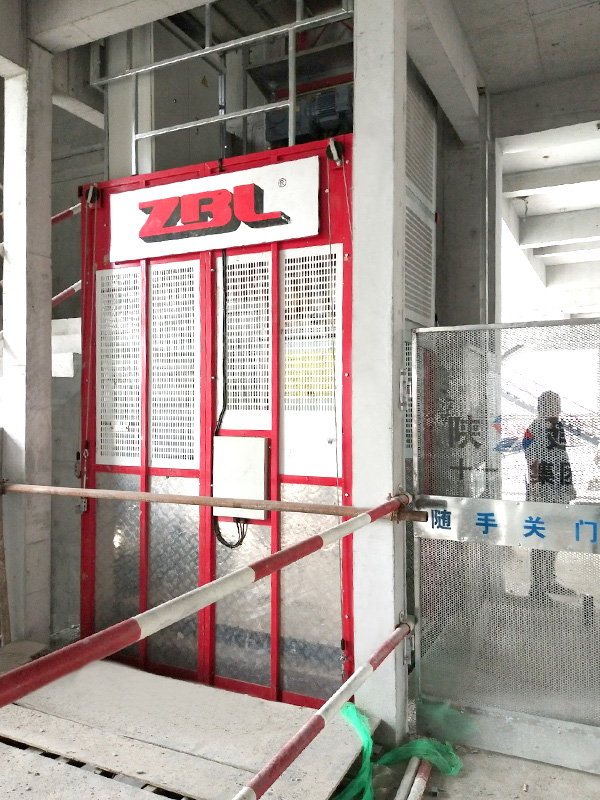 SC200 Series Construction Hoist for High-Rise ProjectsThe static hold test verifies whether the hoist's holding capacity matches rated load at actual site voltage, making this series a reliable choice for rigorous commissioning.View Product →
A common mistake is to treat the brake as a parking brake. During the static hold it is doing real work, and the test reveals whether holding capacity matches the rated load at the site's actual voltage. Record hold time, load value, and any displacement. A few millimetres of creep inside the first minute is different from continuous drift; the report should distinguish the two.
The static test does not fail the machine; it fails the installation — and that is exactly why it comes first.
Dynamic load testing: the drive changes what you measure
If the static test proves capacity, the dynamic test proves control. At full rated load, the cage travels the entire mast height with repeated starts and stops, and the measurements shift from structural behaviour to drive behaviour.
The type of drive determines where the problems show. On a fixed-speed hoist, attention goes to acceleration peaks, stopping distance, and mechanical shock when the brake engages. On a variable-frequency unit, the list grows: ramp times, jerk limiting, current draw during startup, VFD fault codes, and the behaviour of the brake during the pre-torque phase. The variable-frequency medium- and high-speed construction hoist in the current product range illustrates why drive settings belong in the test record — a change in deceleration ramp alters stopping distance, which alters the acceptable range for the brake test.
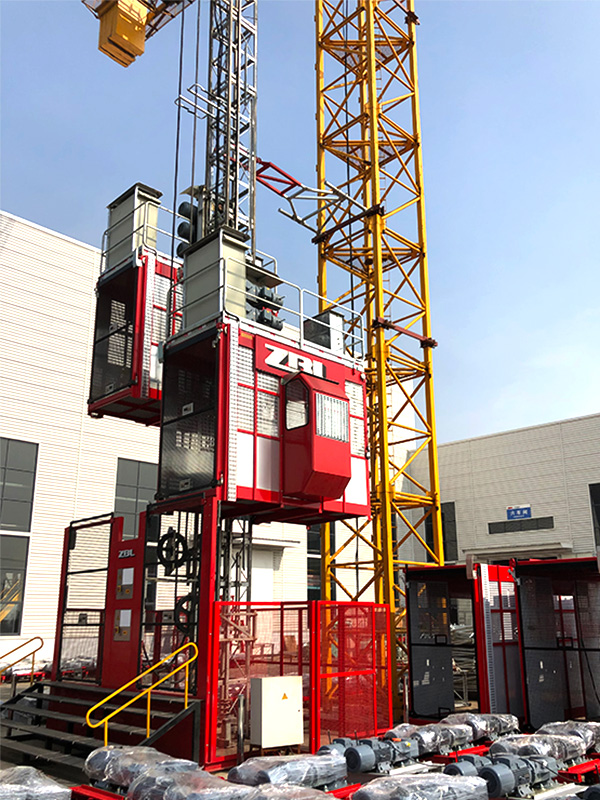 Variable Frequency Medium and High Speed Hoist SC200/200With speed options up to 96 m/min, this hoist demands attention to drive settings and ramp times, essential for accurate brake and stopping distance tests.View Product →
A closer look at how the 37 kW variable-frequency drive enhances the SC200-200's performance explains why commissioning data must be read with drive parameters in hand. The same hoist behaves differently with default ramps and tuned ramps; neither setting is wrong, but only one will match the numbers written in the handover report.
The safety chain deserves its own tests
The safety gear, overspeed governor, and brake form a chain that only matters when something else fails. Testing it is non-negotiable, and the drop test is the only realistic way to confirm the chain responds as a unit.
The rule is simple: the drop test must be conducted by certified professionals, and no one stands inside the cage during the test.
Never allow personnel inside the cage during a drop test. The test exists to prove what happens when normal support fails, and that is exactly when a restrained observer is most at risk.
Beyond the drop test, the governor trip point and the safety gear wedges need their own verification. Inspect, clean, and function-test the safety gear at specified intervals; a safety gear that has never been exercised may no longer engage. Intelligent hoist models add a useful extra layer: the control system records trip events, brake cycles, and load history, which gives the next inspection a starting point instead of a blank page.
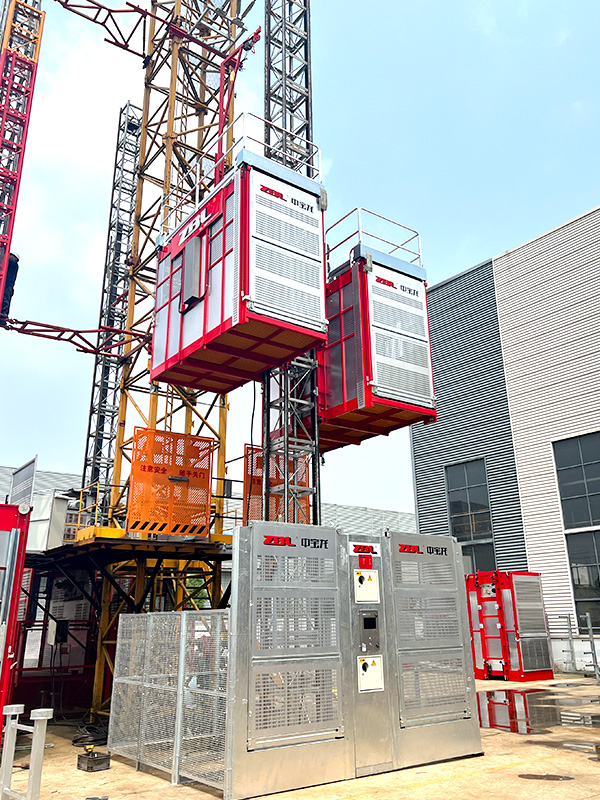 SC200/200ZN Intelligent Construction HoistIts intelligent control records trip events and brake cycles, simplifying inspection and supporting safe, efficient vertical transport in demanding construction environments.View Product →
Treat brake stopping distance as a range, not a single number. Temperature, load, and drive settings all shift it. Record the conditions alongside the measured value, and compare like for like in the next periodic test.
Building a commissioning protocol from the test system
The order of tests matters because each step protects the next. Running the dynamic test before the static test risks loading a structure that has not yet been proven; running the drop test first risks damaging components that a slower test would have flagged.
The sequence that protects the equipment
- Pre-test inspection and documentation review — mast plumb, bolt torques, welds, electrical connections, and the load chart.
- Unloaded cycling over the full travel range to confirm basic operation and limit switch sequence.
- Static load test at the specified proof load, with deflection and brake hold measurements at multiple heights.
- Dynamic load test at full rated load, including repeated starts, stops, and direction reversals.
- Safety device verification: governor trip, safety gear engagement, and emergency stop response.
- Speed, acceleration, and stopping-distance measurement with the final drive settings locked in.
- Report and sign-off, including instrument calibration dates, weather conditions, and corrective actions taken.
When test records are kept consistently, they become the equipment's baseline. The second periodic test is faster and more accurate because every comparison starts from a known, documented point rather than from memory.
What a test system buys over the life of the hoist
The direct benefit of a construction hoist test system is a safe handover. The indirect benefit is a maintenance history that makes every later decision easier: when vibration appears six months in, the test records tell you whether it existed at commissioning; when a drive parameter is changed, the speed and stopping-distance measurements tell you the real effect.
- Compare future vibration and noise readings against commissioning values.
- Verify that drive parameter changes produced the intended effect.
- Plan maintenance around real load cycles rather than calendar guesses.
Projects using intelligent hoist features, such as the Xi'an Caojiatan innovation centre smart unmanned well ladder project, show how test data connects to site management. When the control system logs load cycles and trip events, the baseline becomes a management tool rather than an archived file.
Schedule pressure is the most common reason tests are shortened. The danger is not the skipped minute; it is the lost baseline. A hoist that is handed over without a complete test system in place is a hoist whose history starts with a gap — and gaps are expensive to close later.
